
Finding the best outdoor security cameras shouldn’t be a headache. You deserve to feel completely safe, never vulnerable, in your own home. Whether you need sharp night vision or a simple wireless setup, we tested the top options to help protect your family. Stop stressing about your property and start enjoying real peace of mind today. Let’s dive into the top-rated choices available right now.
Contents
- Top 5 Outdoor Security Cameras:
- 1. Google Nest Cam – Best Outdoor Security Camera Overall
- 2. REOLINK Duo 3 WiFi – Best Ultra-Wide Coverage Outdoor Security Camera
- 3. eufy Security SoloCam S340 – Best Solar Pan & Tilt Outdoor Security Camera
- 4. Ring Floodlight Cam Wired Plus – Best Outdoor Security Camera with Floodlight
- 5. WYZE Cam v4 – Best Budget Outdoor Security Camera
- Things to Consider Before Buying a Outdoor Security Camera:
- Wired Cameras
- Wireless Cameras
- Bullet Cameras
- Dome Cameras
- Resolution and Image Quality
- Night Vision Capabilities
- Field of View
- Weather Resistance
- Advantages of Installation
- Installation Requirements
- Regular Maintenance Tasks
- Common Issues and Solutions
- Summing up
Top 5 Outdoor Security Cameras:
1. Google Nest Cam – Best Outdoor Security Camera Overall
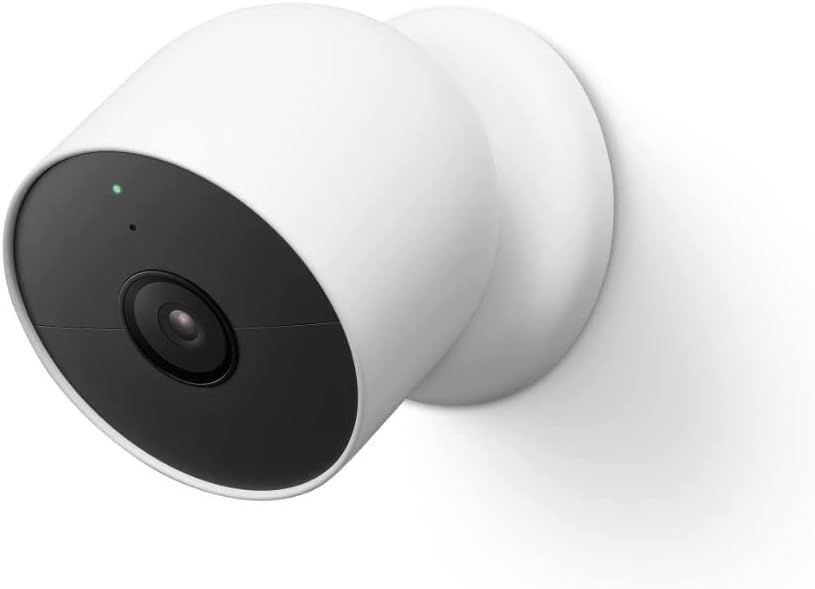
The Google Nest Cam (Battery) is an excellent “set it and forget it” option if you’re looking for an outdoor security camera with enough intelligence to cease alerting you whenever a shadow moves across the screen. With its integrated intelligence, it can distinguish between humans, animals, and vehicles, allowing you to receive only the important notifications through the Google Home app and avoiding constant false alarms.
Additionally, it is designed for practical use, not idealized Wi-Fi fantasies. Nest Cam can record for up to an hour in the case that your Wi-Fi goes down or the power goes out. This way, you can still view what happened during the outage, which is when something “interesting” is likely to have happened.
Putting it all together is surprisingly easy. You won’t have to worry about finding an outlet because it runs on batteries, so you can put it nearly anywhere outside. This isn’t simply a “works on drywall” type of affair; the magnetic mount makes installation a breeze, and the Outdoor version comes with a wall plate that can be used to put it on more durable surfaces like brick.
You can also use the two-way audio to communicate through the camera, which is useful for a variety of situations like instructing a delivery person on how to leave a product or gently removing an unwanted guest.Plus, if you prefer to keep an eye on things without using your hands, you can use Google Assistant to stream the live feed on compatible smart displays, or Amazon Alexa on compatible smart displays, smart TVs, and tablets.
2. REOLINK Duo 3 WiFi – Best Ultra-Wide Coverage Outdoor Security Camera

Say goodbye to “camera Tetris” and hello to an ultra-wide watchdog that can cover your entire driveway and front yard with a single shot: the REOLINK Duo 3 WiFi. Instead of zooming into a hazy blob and labeling it “evidence,” you get fine detail because to its dual 4K image sensors, which give a large 16MP view.
Additionally, the dual-image stitching provides a full 180° panorama with minimum distortion, eliminating blind patches and providing no room for sly side-walkers. You won’t have to scrub through film like a detective documentary thanks to Motion Track, which can display the whole trajectory of an object, person, or vehicle across time in a single frame.
There is no nighttime blindness. The eight spotlights, huge aperture of F1.6, and two night vision modes let you to select between infrared (IR) for a more covert appearance or vibrant color night viewing. It can send you real-time notifications to your phone and activate the siren and lighting when it senses movements, giving you the impression that you are on camera instantly.
For uninterrupted live streaming and instant alerts, Wi-Fi 6 ensures a faster and more robust connection. The IP67 rating ensures it can withstand actual weather conditions, not just “nice day” conditions, and the installation is highly adaptable.
3. eufy Security SoloCam S340 – Best Solar Pan & Tilt Outdoor Security Camera

The eufy Security SoloCam S340 is a great solar-powered upgrade for outdoor security cameras because it runs on daylight and doesn’t require continual monitoring. In contrast to gazing at a pixelated “maybe that’s someone” moment, it records events in crisp 3K quality and provides an 8× zoom, allowing you to discern what’s happening—up to around 40 ft.
One of the finest features is the power setup. It maintains its own charge and readiness with a detachable solar panel, so after you install it, you won’t have to worry about replacing the batteries as often. You may go about your day with complete peace of mind knowing that this camera is constantly recording.
Its true value lies in the coverage it provides. By mounting it vertically, you can enjoy 360-degree pan-and-tilt monitoring, which gives you a bird’s-eye view of your entire property and eliminates blind spots. No more enduring the annoyance of “it happened just outside the frame”—this one is capable of seeing around.
Setup will not eat up your weekend. Eufy boasts that you can have it up and operating in approximately 7 minutes because to its small, wire-free design, which means less drilling, less cable wrestling, and fewer “why did I start this today?” thoughts during installation.In one simple, low-maintenance camera, you get clear 3K detail, full-circle coverage, and the simplicity of solar power—so your home stays watched without you having to become the maintenance crew.
4. Ring Floodlight Cam Wired Plus – Best Outdoor Security Camera with Floodlight

The Ring Floodlight Cam Wired Plus is the tough outdoor security camera you’ve been searching for if you want it to do more than just keep an eye on your yard. A 105 dB siren, motion-activated LED floodlights, and 1080p HD footage allow the camera to highlight moving objects.Because inquisitive minds don’t work on a clock, the Ring app has a Live View feature that allows you to check in at any time, and alerts are sent to your phone, tablet, or computer the second motion is detected. Additionally, you have the option to personalize the motion zones, allowing you to avoid being inundated with notifications whenever a tree greets you or a vehicle passes three streets away. Prioritize the parts of your property that are most important, such as the driveway, porch, and side gate.
At night, it does its best work. You won’t have to guess what’s going on because of shadows thanks to the built-in Color Night Vision and the dual floodlights.It is designed for continuous power supply since it is wired. Without bothering about battery swaps or annoying “low power” pop-ups, you can enjoy constant, always-on coverage when you hardwire it outdoors and connect it to Wi-Fi.
Also, you can use Two-Way Talk to communicate through the camera, which is useful for a variety of situations like directing a delivery person or alerting an intruder to your presence. It functions similarly to a porch light with an added layer of protection; it is strong, audible, and dependable.
5. WYZE Cam v4 – Best Budget Outdoor Security Camera

A surprisingly packed little update for your house, the WYZE Cam v4 is a budget security camera that nevertheless seems like it’s wearing a quality label. With the crisp 2.5K QHD resolution, you won’t have to worry about zooming into a fuzzy blob and trying to tell if that’s a delivery guy or your neighbor’s heroic cat.
At night? It maintains composure. You can see what’s happening in color instead of the typical eerie black-and-white film vibe, thanks to enhanced color night vision, which keeps things bright long after dark. With Wide Dynamic Range enabled, the camera is better able to deal with challenging lighting conditions, such as strong ambient light, deep shadows, and glare, preventing the loss of detail.
When it senses motion, it can activate a siren for added “wrong house, buddy” intensity, along with an integrated light and voice warning. It’s an excellent deterrent against unwelcome guests, or at the very least, it will make them reconsider their life decisions.
Additionally, WYZE enhances the audio by utilizing a more powerful amplifier and an upgraded microphone, as the ability to converse makes a camera much more valuable. Whether you’re directing a courier to a specific location or just checking in on someone’s whereabouts, your two-way chats will sound more crystal clear.You may enjoy crystal-clear video, enhanced night color, intelligent lighting managing, and built-in deterrents without breaking the bank.
Things to Consider Before Buying a Outdoor Security Camera:
Camera placement, image quality, connectivity and power options determine how effective your system will be, so you must assess lighting, weather resistance, field of view, resolution, night vision, storage and privacy settings before purchase. Compare subscription costs, whether it integrates with your smart home, and local regulations to ensure the camera meets your security needs, budget and maintenance capacity.
Wired Cameras
You’ll find wired PoE cameras deliver stable feeds with low latency and full-time power; IEEE 802.3af/at over Cat5e gives you up to 100 m per run and supports 2-4K sensors for license‑plate or long‑range captures, but expect conduit and labor for neat installations.
Wireless Cameras
You can install wireless cameras without running cables, choosing between mains-powered Wi‑Fi models and battery units that last roughly 3-12 months depending on event frequency; just account for Wi‑Fi strength, possible cloud fees, and slightly higher latency than PoE.
You should check radio and cloud specifics: 2.4 GHz offers about 2-3× the range of 5 GHz but at lower throughput, while 5 GHz reduces interference for 1080p/4K streams; plan ~2-4 Mbps upstream per 1080p camera, use WPA2/WPA3 encryption, and consider mesh extenders if RSSI drops below −65 dBm – Arlo and Ring battery models often quote 3-6 months between charges under moderate motion.
Bullet Cameras
You’ll use bullet cameras where you need visible, long‑range coverage; their cylindrical housings pair with varifocal lenses (2.8-12 mm) to reach 60-120 ft detection, making them common for driveways and perimeter fences where deterrence matters.
You should expect rugged weather ratings (IP66/67), built‑in IR night illumination effective to ~30 m on many units, and easier aiming via adjustable brackets; opt for varifocal or motorized zoom if you require both wide context and license‑plate detail from the same mount.
Dome Cameras
You’ll prefer domes for low‑profile, tamper‑resistant installs over entries or porches; many offer IK10 housings, wide fields of view (90-180°), and unobtrusive ceiling mounts that reduce blind spots in high‑traffic zones.
You should choose fixed or PTZ domes based on coverage needs: fixed domes provide constant wide coverage with fewer moving parts, while PTZ domes offer 360° pan and up to 20-30× optical zoom for large areas; anti‑glare and vandal shields help maintain image quality in bright or adversarial conditions.
Resolution and Image Quality
You should pick resolution based on the scene: 1080p (2MP) usually suffices for general monitoring, while 4K (8MP) lets you read license plates or distant faces at 20-40 ft. Expect 4K streams to use roughly 8-12 Mbps with H.265 compression at 15-30 FPS; choose cameras with good dynamic range (120 dB DR) to handle backlit porches and sun glare.
Night Vision Capabilities
You’ll compare IR distance and sensor sensitivity: standard IR gives 30-50 ft, enhanced IR or low-light “starlight” sensors extend to 70-100 ft, and color night vision with white LEDs can reveal clothing color. Check lux ratings-0.01 lux or lower indicates strong low-light performance for non-illuminated scenes.
Many systems use 850 nm IR (visible red glow) or 940 nm (no-glow); 940 nm is stealthier but sacrifices range. Adaptive IR and local tone-mapping prevent overexposure of close objects, and sensors like Sony STARVIS deliver usable color down to ~0.001-0.01 lux-useful when you need ID-level detail at night.
Field of View
You must balance coverage and detail: typical wide-angle options range 70°-180°. A 90° lens concentrates pixels for clearer faces at 20-30 ft, while a 130° lens covers porches and driveways in one frame but reduces per-object resolution-fisheye 180° gives maximum coverage but needs dewarping for usable detail.
To estimate coverage, use width ≈ 2 × distance × tan(FoV/2). For example, at 20 ft a 90° FoV covers ~40 ft across, whereas a 130° lens covers ~86 ft-so choose FoV based on mounting height and the distance to critical targets to ensure readable pixels on faces or plates.
Weather Resistance
You should match IP ratings and temperature specs to your climate: IP65 resists water jets, IP66 withstands heavy seas/water jets, IP67 tolerates immersion to 1 m. Look for operating ranges like -20°C to 50°C (-4°F to 122°F) and UV-stable housings if the camera faces direct sun.
For coastal or industrial sites pick salt-spray coatings, sealed cable glands, and conformal-coated PCBs; NEMA 4X or IP67-rated units perform better in corrosive environments. If winters dip below -20°C, specify cameras rated to -30°C or add heated housings to avoid failures.
Advantages of Installation
You get both deterrence and forensics: visible cameras often cut local theft by 20-60%, 4K models can capture plates at 30-50 ft, and person-detection reduces false alarms while improving actionable alerts. You also gain real-time mobile viewing, event clips, and potential insurance savings (commonly 5-20%), letting you balance one-time hardware costs against recurring cloud or NVR choices to match your budget and risk profile.
Installation Requirements
You must decide whether to run Ethernet for PoE (Cat5e/6 supports up to 100 m/328 ft) or use battery/solar to avoid wiring; each affects placement. Mount cameras about 8-10 ft high with a 30-45° downward tilt for reliable face capture. Check surface type-stucco, brick, or wood need specific anchors-and confirm an IP66/IP67 rating if exposed to storms.
You should prep tools: drill, masonry bits, silicone for cable grommets, level, and anchors matched to your wall. If you need runs beyond 100 m, plan PoE extenders or fiber; for exposed Ethernet use conduit and surge protection. Note battery runtime can drop ~20-30% below freezing, and angle placement should avoid pointing at neighbors’ windows to limit privacy issues.
Regular Maintenance Tasks
Clean the lens and IR windows with a microfiber cloth monthly and inspect mounts and seals quarterly, especially after high winds or heavy rain. Update firmware and app versions every 4-12 weeks to patch bugs and improve detection algorithms. Test live view and motion recordings weekly, verify SD card write health (reformat or replace every 6-12 months), and tighten fasteners or reposition cameras after any property work.
Common Issues and Solutions
Wi‑Fi dropouts often stem from distance or interference; move the camera closer, switch to 2.4 GHz for range, or add a mesh node within 15-30 ft. False motion alerts typically come from foliage, headlights, or pets; reduce sensitivity, set smaller motion zones, or enable person/vehicle detection. Poor night vision can be fixed by cleaning IR emitters and eliminating nearby glare, while SD card corruption is resolved by reformatting or using high-endurance cards.
In practice, small changes deliver big improvements: lowering sensitivity and tightening motion zones can cut nuisance alerts by more than half for many users, and installing a Wi‑Fi extender within 20 ft often restores near‑100% uptime for cameras that previously dropped every few hours. If you still see frequent SD errors, swap to an industrial or “high‑endurance” microSD rated for continuous write cycles and replace it annually to minimize footage loss.
Summing up
As a reminder, you should assess your coverage needs, image quality (day/night), and weather resistance; decide between wired or battery power and Wi-Fi or wired connectivity; evaluate motion detection accuracy, storage options, and privacy policies; consider mounting, field of view, and integration with your smart home; and balance features against cost and any subscription fees before you buy.
Leave a Reply