
Finding the best VR headsets can feel like a confusing maze. You crave breathtaking, immersive gaming without the headache of lag or blurry screens. Don’t settle for a bad experience when you can explore stunning virtual reality worlds that feel truly alive. We tested the top gear to save you time and money. Discover which game-changing device will transform your home into a limitless universe right now.
Contents
- Top 8 VR Headsets:
- 1. Meta Quest 3S 128GB
- 2. PlayStation VR2
- 3. PlayStation VR2 Horizon Bundle
- 4. Meta Quest 3 512GB
- 5. HTC Vive XR Elite with Deluxe Pack
- 6. Meta Quest Pro
- 7. HTC Vive Focus Vision
- 8. HTC Vive Pro 2 System
- Things to Consider Before Buying a VR Headset:
- Standalone vs. PC-Tethered Systems
- Console-Based and Mobile Solutions
- Display Resolution and Refresh Rates
- Tracking Technology and Field of View
- Immersion and Educational Benefits
- Physical Space Requirements and Health Considerations
- Assessing Hardware Compatibility
- Setting a Realistic Budget
- Testing Comfort and Ergonomics
- Evaluating Content Libraries and Ecosystems
- Final Words
Top 8 VR Headsets:
1. Meta Quest 3S 128GB

Similar to Meta’s flagship, the Quest 3S is powered by the Snapdragon XR2 Gen 2 microprocessor. It also shares the same 8GB RAM and complete game catalog.Important features include a 96° field of view, 120Hz maximum, 514g weight, Wi-Fi 6E, and a resolution of 1832×1920 per eye.Excellent standalone performance is on display here, with even the most taxing games running without a hitch and wireless PC VR streaming functioning without a hitch.
What they leave out is this: God rays become more apparent when the edges of a Fresnel lens become blurrier. 58, 63, or 68 mm are the only three constant positions offered by IPD. Neck discomfort occurs after 30 minutes of wearing the stock strap due to its front-heavy design.Top pick for families and individuals looking to get their first virtual reality headset. Not for those who care about lens quality.Virtual reality’s most approachable next-gen platform right now.
2. PlayStation VR2

When it comes to displays, the PSVR2 is head and shoulders above the competition. Its two OLED panels provide genuine blacks and HDR contrast LCD displays that no one else can match.Important features include: 560g, eye tracking, adaptive trigger Sense controllers, 120Hz, 110° field of view, and 2000×2040 OLEDs per eye.Wherever you look, details will be rendered thanks to eye tracking. Using the adaptive triggers on the Sense controllers, manipulating a bowstring or pressing a brake feels incredibly realistic.
Checking in with reality: totally useless without a PS5. While playing games, the USB-C cord, which is required, gets tangled. The library is thin and curated, but first-party support from Sony has waned.Ideal for PS5 owners seeking an immersive OLED display. Do not attempt if you do not own a PlayStation 5 or despise cords.With its OLED display and tactile depth, this tier is unmatched.
3. PlayStation VR2 Horizon Bundle

For just extra than the standalone headset, you can get Horizon: Call of the Mountain packaged with the same PSVR2 hardware – the exact same display and Sense controllers.Horizon showcases spatial audio, adaptive triggers, eye tracking, and headset haptics all at once in its PSVR2 build.The hardware’s climbing and archery mechanics showcase its capabilities to the fullest.
You should be aware that the same restrictions apply: a PlayStation 5, a wired connection, and a slimmer, more extensive library. The content shortfall becomes apparent as Horizon’s six-hour promotion concludes.Ideal for first-time PSVR2 purchasers seeking the pinnacle of display options. Not for PS5 users or current owners of Horizon.Every time, get the package.
4. Meta Quest 3 512GB

The Quest 3’s pancake lenses are what make it the top solo virtual reality headset in 2026.Important specifications include a depth sensor, 512GB of storage, Wi-Fi 6E, a 120Hz maximum refresh rate, pancake lenses with a field of view of 110°, a continuous image processing distance (IPD) of 58-71mm, and a pixel density of 2064×2208.Pancake lenses eliminate glare and provide clear vision from corner to corner. Virtual worlds seem more vast with to the 110° field of view, and mixed reality is more precise thanks to the depth sensor compared to the 3S.
Problematically, under strain, the battery life hardly exceeds two hours. It is front-heavy on the stock strap. Additionally, casual users will find the 3S upgrade to be excessive.On par with the best for PC VR streamers and occasional VR users. Avoid the Quest 3S if you’re only a casual user.The benchmark for independent virtual reality systems.
5. HTC Vive XR Elite with Deluxe Pack

The 260g VR glasses, perfect for PC use or travel, become the XR Elite’s most notable feature when you remove the battery cradle.Important features include: 90Hz, 110° field of view, per-eye diopter knobs, a hot-swappable battery, Wi-Fi 6E, 12GB of RAM, and 1920×1920 per eye with pancake lenses.With the diopter dials, people who use glasses can get by without a prescription altogether. Once set up, PC VR streaming over Wi-Fi 6E is a breeze.
One drawback is that demanding standalone games are a bit much for the Snapdragon XR2 Gen 1 CPU. For independent media, VIVEPORT is severely lacking. In this respect, Maximum 90Hz lags behind rivals.This lightweight wireless solution is perfect for PC VR aficionados and those who wear glasses. Do not expect to play games at 120 Hz or more on your own.
6. Meta Quest Pro

With features including self-tracking controllers, eye and facial tracking, and a QLED display with 500-zone local dimming, the Quest Pro is Meta’s prosumer MR headset.The following are the main specifications: 12GB RAM, 256GB storage, 722g, eye and face tracking, 90Hz, 106° field of view, pancake lenses, 1800×1920 QLEDs per eye.With face tracking, avatars can show emotions in real time that no other headset can replicate.Wear time is increased thanks to the rear-mounted battery, which provides a stable base of support.
What follows is essential information: This was removed from Meta’s inventory in September 2024. The battery life is the greatest of its kind, lasting no more than one or two hours at most. With better resolution and field of view, the Quest 3 beats it.For business MR users and VRChat enthusiasts looking for expression mirroring, this is the best option. Ideal for shorter sessions or casual gaming.Robust gear—but it’s hard to sell because it’s been discontinued.
7. HTC Vive Focus Vision
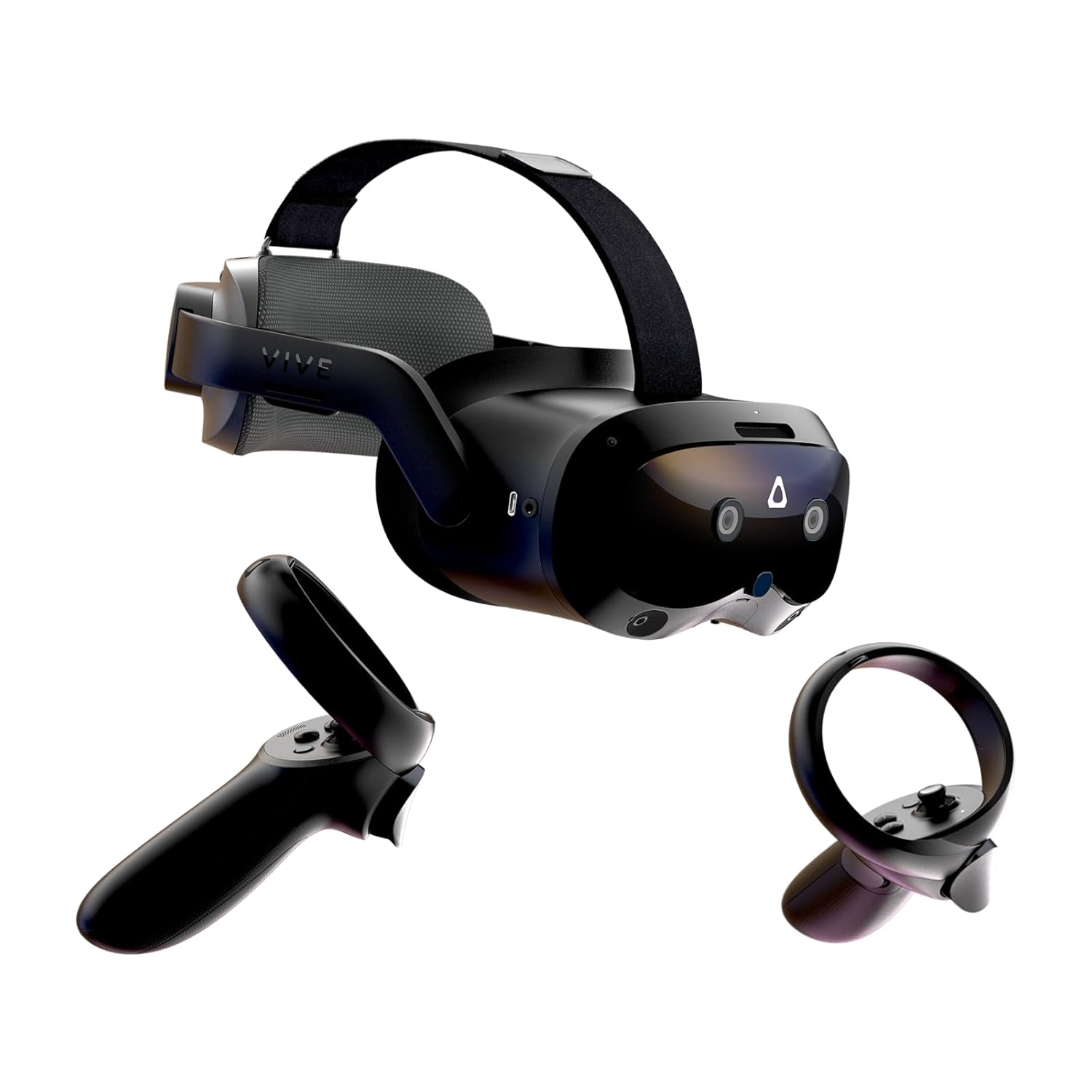
The Focus Vision eliminates the need for two separate devices by functioning as both a standalone headset and a lossless wired PCVR through DisplayPort.Important features: each eye has a resolution of 2448×2448, the lenses are Fresnel, the refresh rate is 90Hz when used alone or up to 120Hz when connected to DisplayPort, the field of view is 116°, auto-image pixel detection is enabled by eye tracking, the battery can be swapped out quickly, there is 12GB of RAM, and Wi-Fi 6E is supported.
An actual competitive edge for businesses is auto-IPD with eye tracking, which quickly aligns lenses to perfection.The plain truth is that this is severely limited by using the Snapdragon XR2 Gen 1, which is also used in the 2020 Quest 2. You can purchase the DisplayPort streaming kit separately for an additional. God rays, introduced by Fresnel lenses, are inappropriate for this price point.Ideal for business groups and PCVR fans seeking both wireless and standalone functionality. For serious gamers only.Very impressive business tool, but not really consumer-friendly.
8. HTC Vive Pro 2 System

At 5K combined, with 2448×2448 per eye, the Vive Pro 2 boasts the highest resolution in this series, and it’s noticeable.Important specifications: 5K combination LCD, 120° field of view, Fresnel lenses, DisplayPort 1.4, SteamVR Tracking 2.0 base stations, high-resolution headphones, and a gaming PC is required.There is no longer any screen-door effect due to high pixel density. When it comes to tracking, the SteamVR base station is the most accurate, providing faultless 360-degree movement.
Important note: there is no standalone mode; it is only compatible with wired PCVR. A minimum of an RTX 2060 is implied. In bright-on-dark settings, god rays are introduced by Fresnel lenses. Most customers upgrade separately after the Vive Wands were designed in 2016.This is the ideal choice for PCVR simulation fans who value detail above everything else. Not recommended for use on its own or by those without a powerful computer.If you’re open to constructing around it, this VR display is the sharpest one currently available.
Things to Consider Before Buying a VR Headset:
Buying a VR headset requires careful evaluation of multiple factors to ensure it meets your needs. Consider compatibility with devices, display resolution, comfort, available content, and budget. Understanding these aspects will help you make an informed decision for an optimal virtual reality experience.
Standalone vs. PC-Tethered Systems
Standalone headsets operate independently, providing convenience and portability. In contrast, PC-tethered systems leverage the power of a connected computer, delivering superior graphics and more immersive experiences. Your choice hinges on whether you prioritize accessibility or high-quality visuals.
Console-Based and Mobile Solutions
Console-based VR offers tailored experiences for specific gaming platforms, while mobile solutions provide portable and affordable options. Each type caters to different user needs and preferences, ensuring everyone can find a suitable solution.
Console-based systems, such as PlayStation VR, deliver tailored content and experiences designed specifically for gaming enthusiasts. Often featuring exclusive titles, these headsets integrate seamlessly with their respective consoles, enhancing gameplay. Mobile solutions, on the other hand, like those compatible with smartphones, cater to users seeking an entry-level VR experience. Although limited in power and capability, they offer convenience and affordability, making it easier than ever to explore the world of virtual reality.
Display Resolution and Refresh Rates
High display resolution and refresh rates significantly enhance your VR experience. A sharper image and smoother motion reduce motion sickness and improve immersion.
Tracking Technology and Field of View
The tracking technology determines how accurately your movements translate into the virtual space. A wider field of view allows for a more immersive experience, making it crucial for gameplay and exploration.
Various tracking technologies, like inside-out tracking or external sensors, provide different levels of precision. A larger field of view (FOV) enhances your peripheral vision, making interactions feel more organic and less restrictive. Researching these features helps ensure you select a headset that offers an engaging experience tailored to your preferences.
Immersion and Educational Benefits
VR enhances immersion, allowing you to investigate rich experiences that transform learning. Educational opportunities expand with interactive simulations, making complex concepts more accessible and engaging. Such benefits can significantly improve retention and comprehension in various subjects.
Physical Space Requirements and Health Considerations
Space availability is key for safe VR use. Ensure you have enough room to move without obstacles. Health-wise, be mindful of potential discomfort, such as eye strain or motion sickness, and take regular breaks to maintain well-being during sessions.
Assessing physical space is necessary for a safe VR experience. Ensure your area allows for movement without hazards, as crowded spaces can lead to accidents. Health considerations include potential eye strain, which can occur after prolonged use. Scheduling regular breaks helps mitigate these effects, allowing you to enjoy immersive experiences without compromising comfort. Also, consider your physical limitations when engaging in active VR experiences to prevent injury.
Assessing Hardware Compatibility
Ensure your existing hardware can support the VR headset’s system requirements. This includes checking your graphics card, RAM, and processing power to avoid performance issues.
Setting a Realistic Budget
Identify how much you’re prepared to invest in VR technology. Consider both the initial cost of the headset and any additional expenses like accessories or games.
Costs can vary widely, so researching different models will help you find options within your budget. Take into account potential long-term expenses like software or upgrades, which might impact your overall investment in VR gaming or experiences.
Testing Comfort and Ergonomics
Evaluate how the headset feels during prolonged use. Comfort is paramount, as an uncomfortable fit can lead to headaches and fatigue. Try on various models to find one that suits your head size and shape best.
Evaluating Content Libraries and Ecosystems
Choosing a headset with a strong content library is crucial for an enjoyable experience. Different platforms offer unique games and applications, making it critical to ensure the ecosystem aligns with your interests.
Exploring the available content libraries will greatly influence your decision. Each VR platform has exclusive titles, compatibility with various genres, and subscription models. Check if the headset you are considering supports the content you find appealing, as this can dictate your level of satisfaction with the device.
Final Words
With this in mind, consider your budget, intended use, and comfort level when choosing a VR headset. Research the specifications and compatibility with your devices to ensure an enriching experience. Prioritizing your preferences will lead to a satisfying purchase that enhances your virtual reality enjoyment.
Leave a Reply