
Searching for the best studio monitors to upgrade your sound? It is frustrating when your hard work falls flat outside your home studio. You simply need gear that tells the honest truth. Our guide highlights powerful reference speakers that will instantly transform your mixing accuracy. You will finally create tracks with confidence and hear every crystal-clear detail. Ready to find your perfect match? Let’s dive into the top options for every budget.
Contents
- Top 5 Studio Monitors:
- 1. ADAM Audio T5V – Best Studio Monitor Overall:
- 2. Yamaha HS5I – Best Wall and Ceiling-Mountable Studio Monitor
- 3. M-AUDIO Forty Sixty – Best App-Tunable Bluetooth Studio Monitor
- 4. JBL 305P MkII – Best Studio Monitor for Home Studios
- 5. M-Audio BX5 D3 – Best Budget Studio Monitor
- Things to Consider Before Buying a Studio Monitor:
- Active vs. Passive Monitors
- Nearfield vs. Farfield Monitors
- Size of the Monitor
- Frequency Response
- Advantages of Investing in Quality Monitors
- Acoustic Treatment Considerations
- Matching Monitors to Your Workspace
- Overlooking Room Acoustics
- Ignoring Your Listening Preferences
- Summing up
Top 5 Studio Monitors:
1. ADAM Audio T5V – Best Studio Monitor Overall:
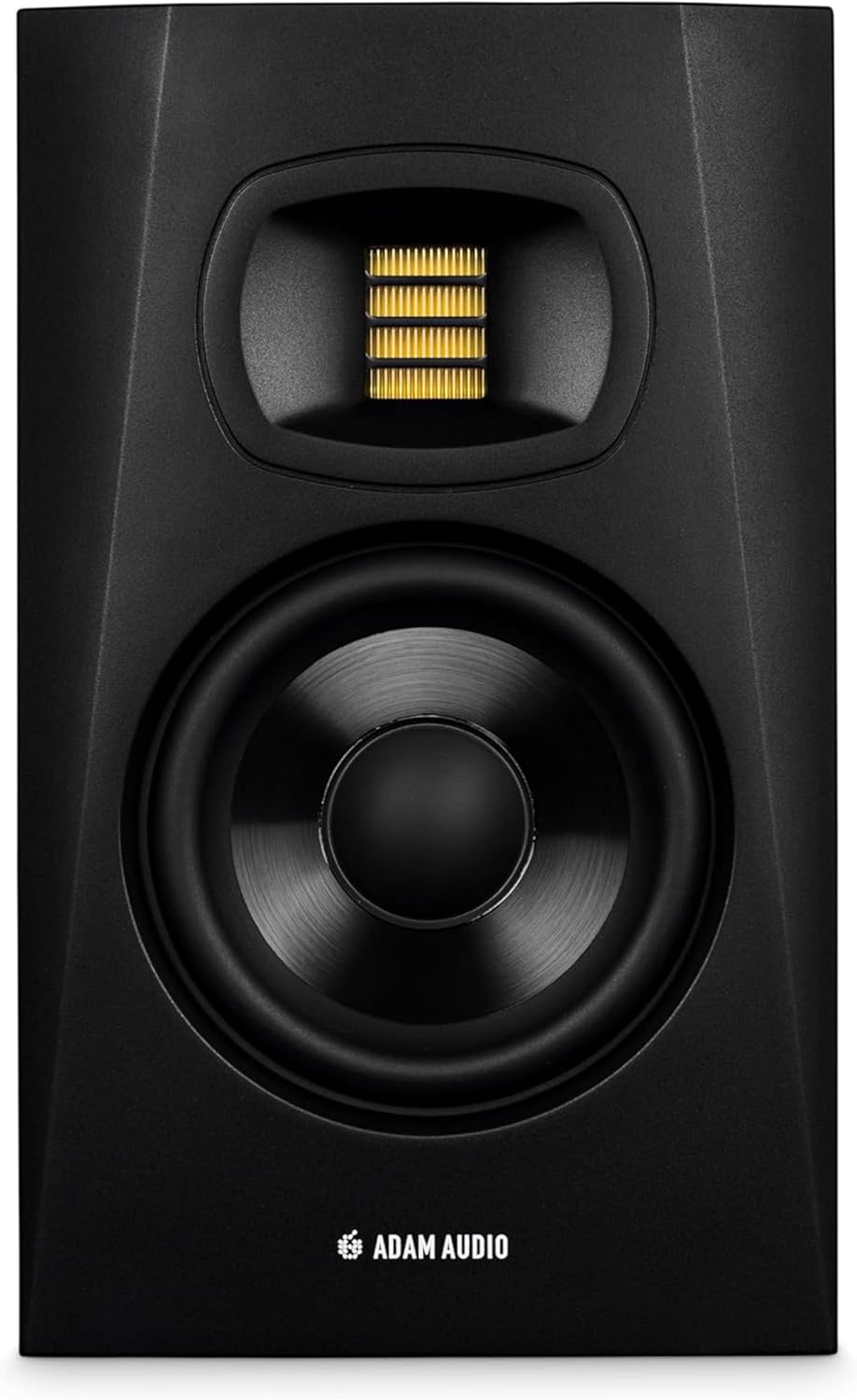
If you’re looking for monitors that aren’t afraid to tell it how it is but still manage to put a grin on your face, these are the ones for you. Whether you’re editing a podcast, tracking guitars, or scoring your next scene, you’ll hear nuances that used to lurk in the corners thanks to ADAM Audio’s trademark tweeter-and-woofer combo, which is revealing in the best way. Better editing, less “why does this sound different everywhere?” and more polished mixes are the results.
Punch is also available sans bloat. The T5V’s 70 watts of power ensures assured volume and headroom, and its 45 Hz low-pass filter allows for serious bass and kick drums. The sound is presented in full stereo, making your panning decisions sound deliberate rather than “eh, close enough.”
Doing work in a physical space? Very much so. With its rear-firing bass reflex port and beveled enclosure, this speaker can be positioned to fit any room. No magic is needed to dial in your environment with DSP low- and high-shelf filters to calm down booming corners or brighten a drab area.Quickly connect your audio interface, mixer, or home setup thanks to the various analog inputs, and you’ll be rocking out in no time. After you’ve set them up, you can start to believe what you hear and make judgments with certainty. Your workflow improves, your tracks become more distinct, and your ears experience a pleasant “ohhh, there it is” sensation.
2. Yamaha HS5I – Best Wall and Ceiling-Mountable Studio Monitor

The HS5I is a tidy truth-teller that can provide harsh honesty to your studio without taking over your desk. Whether you like to mount it on the wall, from the ceiling, out of the way, or into your zone, this installation-ready version of Yamaha’s iconic HS5 comes with mounting points and screws.Featuring a 5″ woofer and a 1″ dome tweeter, these nearfield speakers are bi-amped and known for their bass reflex design. What this means in practice is that there is no sandpapery high end, the kick remains tight, and the vocals sit correctly. The clean headroom of up to 70 watts in stereo is perfect for those “one more take” moments that last three hours, late-night comping, and punchy edits.
Adding mounting to your workflow is more than simply a flex. Get the table out of the way, expand the sweet spot, and secure symmetry so that your rolling decisions feel calculated rather than random. You can prevent low-end building, phase gremlins, and buried doubles from ruining your automobile test using the HS5I’s neutral voice.
Hook it up, stoop down, and get to work. You’ll be able to trust what you hear from session to session, make decisions more quickly, and chase fewer changes. This wall-or ceiling-mountable workhorse is prepared to take you to the next level if you value truthful, unobtrusive monitors that enhance your area and your mixes.
3. M-AUDIO Forty Sixty – Best App-Tunable Bluetooth Studio Monitor

With this app-tunable Bluetooth beast as your new co-pilot, you can achieve studio truth with modern convenience. Whether you’re producing beats, cutting vocals, or polishing a podcast between coffee refills, the M-AUDIO Forty Sixty guarantees clean, loud, and confidently detailed mixes with its 100 watts of bi-amped power.
The low end is handled with grip by a 6.5″ Kevlar woofer, which delivers extended bass that thumps without muck. To top it all off, placement decisions sound solid rather than uncertain thanks to precision Burr-Brown conversion and intelligent DSP, which keep transients fast and stereo imaging locked.
Where it really excels is in control. To adjust the response to your room, whether it’s an echo-y loft or a bedroom studio, you can fire up the Forty Series Control app and dial in a 5-band equalizer. You can even save custom presets. This device’s front panel features Instant Listening Modes, which allow you to tap between “mix,” “voice,” and “reference”—ideal for doing quick reality checks before bouncing.To help you hear clicks, gasps, and low-mid builds that other speakers miss, the DSP crossover is fine-tuned for accuracy. Your listeners understand exactly what you meant; you know the truth even before they do.
This monitor will keep up with your hectic schedule, making it ideal for beatmakers, producers, DJs, mix engineers, and other creatives who rely on their equipment. Get back to crafting music that people want to listen to again and again with this trusty tool that is loud, clear, adjustable, and quick to set up.
4. JBL 305P MkII – Best Studio Monitor for Home Studios

You can’t afford to miss with these JBL 305P MkII monitors if your home studio is aiming for the stars. Your snare will crack, your vocals will sit, and your bottom end will behave rather than bloat thanks to the next-gen JBL transducers that are tuned for accuracy. Thanks to the fine-tuned dampening, transient response is sharpened and bass is lowered, giving the sound considerable weight and eliminating the fuzzy guessing you’ve been dealing with.
Space crunch? Wall too near? Saved by boundary EQ. If the speakers are leaning against a wall or your work area, you can restore a balanced low-frequency response by flipping a couple switches. Listen to what you meant to hear, not what your room wants you to hear.
Also, power isn’t an issue. Gain clear headroom for tracking, mixing, and those random 2 a.m. inspiration binges with a frequency reach of 49 Hz and a maximum of 82 watts per speaker. Because of their wired and stereo nature, they will seamlessly integrate into your existing interface configuration.
The secret ingredient is the vast sweet spot, which allows you to lean, reach, layer takes, and trust your balances off-axis while maintaining a neutral response across a large area. Incorporate a stylish, contemporary design that elevates your area, and you have home-studio monitors that are accurate, maintain the atmosphere, and assist in the global translation of your mixes.
5. M-Audio BX5 D3 – Best Budget Studio Monitor

Get your mixes straightened up if you want them to sound good on all of your speakers without breaking the bank with these affordable champions. Your kick will no longer inflate, your vocals will stand out, and your judgments will be swifter and braver thanks to the 100 watts of clean headroom provided by the M-Audio BX5 D3.
A 5 inch Kevlar woofer provides tight, defined, and never flabby low-end control, and the rear ports have been fine-tuned to extend the response all the way down to 52 Hz without producing the breezy turbulence that muddies up bass. For silky, nuanced highs up to 35 kHz, the 1″ silk-dome tweeter rides a computer-tuned waveguide at the top of the speaker.
No room is flawless. With Acoustic Space Control, you may adjust the output to fit your environment (wall-mounted desk, awkward corners, unusual acoustics) while maintaining the reference’s original sound quality. After only one dial, the sound you hear will be consistent, easy to reproduce, and ready to be translated.
A delightfully astute setup. The speakers can be quickly and precisely placed since the tiny pin-hole LEDs shine brightest when the monitor is at the appropriate angle. What’s more, it’s beautifully repeatable. You can confidently track, produce, or podcast after plugging them into your interface or mixer.
Resulting in tighter lows, more revealing highs, and mixes that get it through the automobile test unscathed is the immediate payoff. Every day, session after session, these monitors provide the kind of clear detail that turns second-guessing into solid choices—if you’re working smart on a smart budget.
Things to Consider Before Buying a Studio Monitor:
Most buyers focus on specs, but you should prioritize how monitors interact with your room and workflow: decide whether active or passive suits your setup, choose driver size and nearfield vs midfield based on room dimensions, check frequency response and SPL for your genre, confirm inputs and amplification compatibility, and audition several models with familiar material to ensure the monitors reveal problems rather than flatter them.
Active vs. Passive Monitors
You’ll find active monitors include matched amplifiers and often built-in EQ or room correction, which simplifies setup-examples: Adam A7X, KRK Rokit G4. Passive monitors need an external amp sized to the speaker’s nominal impedance and power handling; classic passive choices include ATC SCM or Bowers models. In practice, active designs reduce cabling and phase errors at crossovers, while passive systems let you tailor amplification and upgrade components independently.
Nearfield vs. Farfield Monitors
You’ll use nearfield monitors when mixing at 0.6-1.5 m to reduce room effects-common in home and project studios using 5″-8″ woofers like Yamaha HS5/HS8. Farfield monitors serve larger control rooms at distances >3 m with 8″-15″ woofers to evaluate low-frequency behavior and imaging in the actual acoustic space, typical in mastering suites and broadcast rooms.
When you set nearfield monitors, position them as an equilateral triangle with your head (angles ~60°) and measure at 78-85 dB SPL for reference mixes; add a subwoofer if you need extension below ~40 Hz and set crossover near 80 Hz. For farfield setups, treat the room with bass traps and first-reflection panels, and check mixes on both monitor types-mixing on nearfield then verifying on farfield helps ensure translation across playback systems.
Size of the Monitor
Smaller drivers (4-6.5″) give tight imaging and low distortion at typical nearfield distances of 3-6 ft; you’ll get cleaner mids from 5″ designs like Yamaha HS5 or JBL LSR305. When your listening position is beyond 6-8 ft or you need extension below ~50Hz, prefer 8″-10″ woofers or add a subwoofer crossed near 80Hz. Consider amplifier power (50-200W) since larger drivers demand more headroom.
Frequency Response
You want monitors that remain relatively flat across the audible band; many compact nearfields are rated 45-20,000Hz ±3dB, while larger models can reach 30Hz-20kHz. Flat on-axis response and smooth off-axis dispersion determine how accurately your mixes translate to other systems, so prioritize measured response curves over marketing specs.
Measure with a calibrated mic (UMIK‑1) and REW at your listening position to expose room modes and peaks; inspect on‑axis, off‑axis and waterfall plots for resonances. Pay attention to phase and group delay under 200Hz, set subwoofer crossover commonly at 80Hz with matched slopes, and apply bass trapping to control low‑end buildup for truer frequency balance.
Advantages of Investing in Quality Monitors
You’ll hear more accurate frequency balance and imaging, spotting issues like phase cancellations or a 2 dB midrange bump that cheap speakers mask. Professional monitors from brands such as Genelec, ADAM, or Yamaha typically cost per pair but reduce revision time and improve translation to speakers, headphones, and cars, making mixes more competitive on streaming platforms and in clients’ playback environments.
Acoustic Treatment Considerations
You should start with corner bass traps (4-6″ thick) to reduce modal peaks below ~100 Hz, add 2-4″ absorption panels at first reflection points on side walls and ceiling, and reserve diffusion at the rear to keep life without muddying the front soundstage. Aim for an RT60 between 0.3-0.5 s for mixing frequencies 200 Hz-10 kHz, and verify improvements with measurements using a calibrated mic and room-analysis software.
Matching Monitors to Your Workspace
For small rooms under 10 m² pick 5-6.5″ nearfields (e.g., Yamaha HS5, ADAM A5X); midsized rooms (10-20 m²) favor 7-8″ models (HS7, KRK Rokit 7); larger rooms need 10″ or midfield monitors plus a subwoofer if you require energy below ~40 Hz. Keep speaker-to-listener distance around 0.8-1.5 m, sit the tweeter at ear height, and avoid placing woofers within 0.5 m of boundaries to prevent +6 dB boundary gain.
If you need more headroom, choose monitors rated for 100-120 dB SPL and 100 W+ amp power; consider a 3-way or larger-form-factor monitor (e.g., Genelec 8040/8351) in untreated rooms for flatter low end. Use DSP room correction (ARC, Genelec SAM) alongside measurement with REW and a calibrated mic, set sub crossover near 80 Hz, and mount speakers on stands with 2-4 cm isolation to reduce cabinet-to-surface coupling.
Overlooking Room Acoustics
In small rooms, room modes and early reflections dominate bass and stereo imaging, so placing monitors against a back wall creates 6-12 dB bass buildup below 100 Hz; you should use bass traps in corners and absorbers at first-reflection points to tame peaks. Positioning at the 38% rule and keeping listening distance 0.8-1.5 m for nearfield monitors like Yamaha HS5 or Focal Alpha helps reduce room interaction and reveal true frequency balance.
Ignoring Your Listening Preferences
If you buy monitors without matching them to the music you produce, tonal choices stand out: electronic and hip-hop need tight, extended bass (below 40-50 Hz), orchestral work benefits from wide dynamic range and crisp highs. Consider frequency response specs like ±3 dB from 40 Hz-20 kHz, and know that Yamaha HS5 lacks low end below ~60 Hz so you’ll need a sub, while KRK Rokit series often emphasizes bass that can mask mix issues.
Test monitors with three familiar reference tracks at both moderate (75-85 dB SPL) and low levels to hear balance and distortion; A/B against headphones and loudspeakers like Genelec 8030A or Adam A7X to expose coloration. Use REW or an RTA with pink noise to check for big dips/peaks, inspect off-axis response for consistent tonality, and factor in your hearing-many people experience high-frequency roll-off after age 30, which should influence monitor choice and EQ decisions.
Summing up
With these considerations you can select studio monitors that suit your room, budget and workflow: prioritize accurate, flat response; match speaker size and power to room; plan placement and basic acoustic treatment; verify inputs, build quality and warranty; audition with familiar tracks and compare multiple models so your mixes translate reliably across systems.
Leave a Reply