
Finding the best whole house water filters can feel overwhelming when you’re worried about hidden contaminants in your family’s tap. You deserve the peace of mind that comes with pure, refreshing water from every single faucet. A high-quality filtration system removes chlorine and heavy metals, protecting your skin and your plumbing. We’ve tested the top models to help you find the perfect match. Let’s dive into our top picks to transform your water quality today.
Contents
- Top 8 Whole House Water Filters:
- 1: SimPure 2-Stage Whole House Filter
- 2: iSpring 2-Stage Whole House Filter
- 3: iSpring Commercial-Grade 3-Stage
- 4: iSpring 3-Stage Iron & Manganese
- 5: Aquasure Whole House Filtration Bundle
- 6: Aquasure Signature Elite 48K Complete System
- 7: Kind Water Systems E-3000 Salt-Free Softener & Filter
- 8: Aquasana Whole House Water Filter System
- Things to Consider Before Buying a Whole House Water Filters:
- Carbon-Based and Sediment Filter Systems
- Reverse Osmosis and UV Purification Technologies
- Benefits of Point-of-Entry Water Treatment
- Potential Limitations and Operational Costs
- Calculating Flow Rates and Household Consumption
- Verifying Certifications and Industry Standards
- Pre-Installation Site Preparation Requirements
- Integration with Existing Plumbing Infrastructure
- Establishing a Routine Filter Replacement Schedule
- Monitoring System Pressure and Water Purity
- To wrap up
Top 8 Whole House Water Filters:
1: SimPure 2-Stage Whole House Filter

Owners can see exactly what they’re filtering with the SimPure, and it’s the most reasonably priced credible whole-house system available.Notable features include a 10-by-4.5-inch sediment and carbon block filter with a 5-micron pore size, a 1-inch NPT brass port, a clear housing that is free of BPA, and two O-ring seals.Filter changes can be observed by just watching the sediment cartridge darken, eliminating the need for timers or flow checks.
What they don’t tell you is that the clear housings can become yellow in the sun, that the flow decreases when the sediment filter becomes clogged, and that the filters that come with it are generic, so customers usually replace them within a few months.For those looking for the most affordable option for whole-house filtration with visible monitoring, this is the best choice for city water buyers. Avoid using if you’re trying to remove heavy metals, iron, or lead from your well water.Most affordable option for whole-house filtration with aesthetic benefits.
2: iSpring 2-Stage Whole House Filter

Here are the features that iSpring’s best-selling product offers above the SimPure, offered at a price of thirty dollars extra.Filter specifications: 2-stage, 10″x4.5″ sediment and CTO carbon block, 5-micron, 1″ NPT, 50,000-gallon capacity, coconut shell carbon that has been third-party tested, and 99% chlorine reduction.A family of four can use 50,000 liters of coconut shell carbon for about a year, and it significantly outperforms generic carbon in capturing chlorine and volatile organic compounds.
Checking in with reality: it’s still only 2-stage, so iron and heavy metals go through; the plastic head can’t handle hot water lines; and changing the filter every year is a continuing expense.This brand is ideal for city water customers who seek a reliable whole-house water supply. Residents with lead issues or who utilize well water should not use this product.Enhanced carbon, larger user base, and more intelligent Tier 1 purchase.
3: iSpring Commercial-Grade 3-Stage

The world changes when you upgrade to genuine three-stage filtration and big-blue housings.A few important specs: a three-stage, 20″x4.5″ big-blue filter with a 99% chlorine reduction rate, a 100,000-gallon capacity, a 1″ NPT, and 5-micron PP sediment in addition to dual CTO coconut carbon blocks.The capacity and filter life of any Tier 1 system are greatly enhanced when the carbon stages are doubled and the size is increased to 20 inches big-blues.
There are a few drawbacks to consider: the lack of iron or heavy metal removal, the need for a sturdy wall mount due to the plastic housings’ weight of 20+ pounds when full, and the recurring annual cost of filter set changes.Ideal for municipal water customers looking to remove chlorine, bad taste, and odors on a large scale for their families. Do not use if you require lead removal or if your well water has iron stains.Real whole-house filtration begins here.
4: iSpring 3-Stage Iron & Manganese
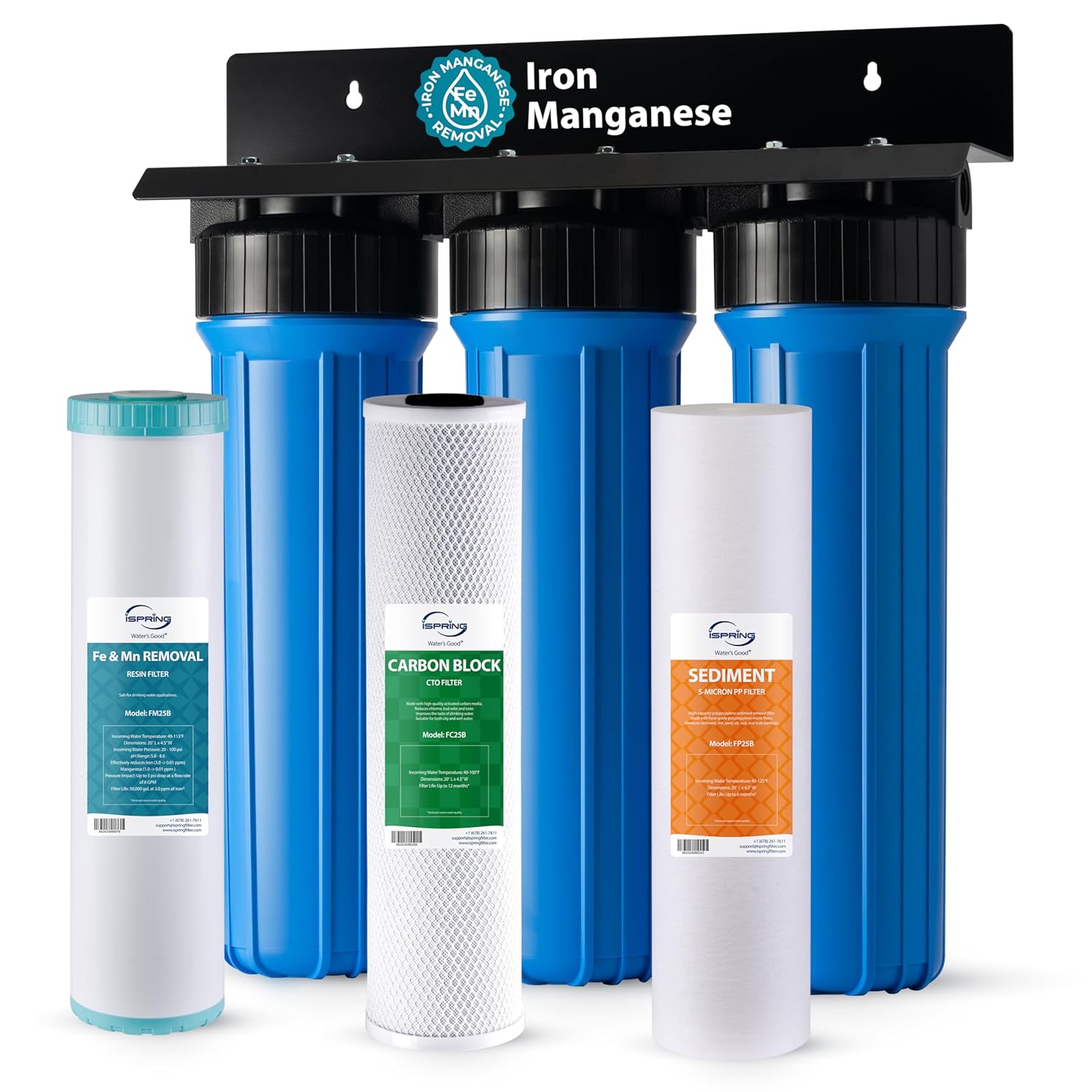
Unlike competing systems, the iSpring can extract manganese and iron from well water.Important specifications: Three-stage, 20″x4.5″ filters, 5-micron PP sediment, CTO carbon block, FM25B iron and manganese reduction cartridge, 1″ NPT, 100,000-gallon capacity.Stage three eliminates problems like metallic taste, rust stains, and discoloration in laundry that not even the iSpring Commercial-Grade or Tier 1 systems can resolve.
Disadvantages: pre-treatment is still necessary for iron levels above 3 PPM, the iron cartridge reduces the lifespan of stages 1 and 2, and separate softening is still necessary for high manganese.For homes with well water who suffer from iron stains and a metallic taste, this is the best option. City water without iron problems or residences with very high iron levels (> 3 PPM) should not be used.The second-best option for the buyer of well water.
5: Aquasure Whole House Filtration Bundle

We are now entering the realm of systems that do all three functions simultaneously: filter, softener, and reverse osmosis.Important features include a digitally metered control head, a 75 GPD RO, a triple sediment/GAC/zinc pre-filter, a 72,000-grain softener, and a capacity that accommodates 1-6 bathrooms.All three functions—softening hard water, filtering chlorine and heavy metals, and adding RO drinking water—are accomplished by a single system. Regeneration of the metered head occurs only when necessary.
The RO membrane often requires expert installation, wastes three gallons for every gallon it produces, and requires salt replacements every month.People looking for a water filter, softener, and RO system all in one may consider this for households with more than one bathroom. Inconvenient for those who don’t have the space or desire to deal with salt and RO membrane maintenance.This Tier 3 water treatment kit is the most comprehensive.
6: Aquasure Signature Elite 48K Complete System

Filter, softener, and RO are all included in the Elite 48K, although on a lesser scale.Features: includes a filter, softener, and RO unit; a 48,000-grain softener; a 75 GPD RO unit; a digitally metered control head; a capacity for three to four bathrooms; automated regeneration; and reduction of chlorine, volatile organic compounds, and heavy metals.There is enough grain for three or four bathrooms in a mid-sized home (48,000 grains) without incurring the costs associated with a larger system. Instead of following predetermined timetables, the digital control head adjusts regeneration times based on actual usage.
Here are some things that should be improved: the smaller brine tank requires more frequent salt top-ups, the usable hardness is capped at 48K grains, and the maintenance ceiling is identical to the larger package.This RO water filter and softener system is ideal for homes with three or four bathrooms. Not suitable for: very hard or very huge houses.Choosing a mid-size home depends on its value.
7: Kind Water Systems E-3000 Salt-Free Softener & Filter

Hard water may be softened without salt, brine, or drain lines using the Kind E-3000, which is something neither of the Aquasana flagship models can achieve.Important specifications: does not include salt, does not discharge brine, does not require a drain line, targets 155+ chemical pollutants (including chlorine and chloramine), and uses sediment and carbon block filtration with NSF certified components.Without the constant maintenance required by Aquasure systems, salt-free softening safeguards pipelines and appliances without requiring salt refills or brine disposal. Consolidating sediment, carbon, and softening into a single, small tank streamlines installation.
Important information: systems that do not use salt merely soften city water by reducing scale, not by eliminating it altogether.The ideal solution for city water customers looking for a salt-free water softener and filter all in one small package. Not recommended for homes with well water, extremely hard water, or customers who prefer more conventional resin-based softening methods.An installation-free solution for hard water control that doesn’t need salt.
8: Aquasana Whole House Water Filter System

This system is the most comprehensive option for a whole house.Important features include a 1,000,000 gallon capacity, 99.99% chlorine, bacteria, viruses, cysts, and scale reduction; an installation kit is supplied; and carbon, KDF, UV sterilization, and salt-free scale control media are all part of the package.No other system in this array can destroy microorganisms and endure a decade as this one can thanks to its million-gallon capacity and UV sterilization. You may avoid the monthly salt refills needed by Aquasure systems with salt-free scale control, which effectively eliminates hard water accumulation.
The facts are: you’ll need to change the UV lamps every year, salt-free scale control only softens the water, not removed it completely, and professional installation is required.Ideal for homes with well water or anyone seeking a million-gallon level of protection against germs, viruses, and scale. Avoid if you’re on a tight budget or if your house is on city water that has a low hardness level.The crown jewel—unlimited UV protection for up to a million gallons—no salt needed.
Things to Consider Before Buying a Whole House Water Filters:
Analyzing different filtration systems reveals key differences crucial for making an informed choice. Each type offers distinct benefits, making it crucial to compare their efficiency, maintenance, and overall effectiveness.
Carbon-Based and Sediment Filter Systems
Choosing carbon-based and sediment filter systems provides excellent initial filtration for removing chlorine, odors, and sediments. These filters excel in improving taste and clarity but may not eliminate all contaminants, making them suitable for pre-filtration stages.
Reverse Osmosis and UV Purification Technologies
Reverse osmosis and UV purification technologies stand out for their advanced filtration capabilities. These systems work to eliminate a wide range of impurities, including harmful microorganisms, ensuring cleaner water for your home.
Reverse osmosis employs a semi-permeable membrane to remove sediments, chemicals, and heavy metals, delivering highly purified water. UV purification effectively sterilizes by using ultraviolet light to neutralize viruses and bacteria that may be present. Together, these technologies provide comprehensive coverage against a broad spectrum of contaminants, making them a strong choice for households prioritizing water safety.
Benefits of Point-of-Entry Water Treatment
Whole house systems provide consistent water quality, ensuring every tap delivers clean, safe drinking water. This comprehensive filtration approach can safeguard your health, reduce contaminants, and improve overall water taste, making daily tasks and consumption more enjoyable and reliable.
Potential Limitations and Operational Costs
Investment in a whole house system often leads to higher upfront costs and ongoing maintenance expenses. Understanding these potential limitations and costs is imperative in deciding if this option aligns with your financial and water quality goals.
Operational costs may include routine filter changes, which can vary in frequency and price depending on the system type. Installation fees may also apply, particularly if professional help is required. Weigh these factors against the benefits to determine the most suitable system for your home and budget.
Calculating Flow Rates and Household Consumption
Evaluating flow rates and consumption helps you select a system that meets your daily water needs without compromising performance. Understanding your household’s peak usage times ensures that the water filter delivers sufficient flow for activities like showering and washing dishes.
Verifying Certifications and Industry Standards
Confirming certifications and industry standards guarantees that the system you choose effectively removes contaminants and meets health regulations. Many independent organizations offer certifications, which can guide your decision-making process.
Researching these certifications ensures that the filter you select meets rigorous testing and safety standards. Look for certifications from organizations like NSF International and the Water Quality Association to establish trustworthiness in the product’s performance. This diligence can help avoid subpar systems that do not deliver the promised benefits.
Pre-Installation Site Preparation Requirements
Identify the best location for your water filter, which should have ample space, access to plumbing, and suitable drainage. Ensure that the area is dry and free of clutter to facilitate easy installation and future maintenance.
Integration with Existing Plumbing Infrastructure
Review your current plumbing layout to determine compatibility with the new water filter. Ensure there are adequate connections available, and be prepared to make adjustments as needed for installation.
Your plumbing system’s layout directly influences how easily the water filter integrates. Evaluate the main water line and any branching pipes to confirm that the filter can be connected without requiring extensive modifications or additional fittings. Take note of pipe sizes and materials to find suitable adapters if necessary.
Establishing a Routine Filter Replacement Schedule
Creating a filter replacement schedule prevents buildup that can hinder performance. Mark your calendar or set reminders every three to six months, depending on your water usage and filter type.
Monitoring System Pressure and Water Purity
Regularly monitoring system pressure and water purity maintains filtering efficiency. Gauge changes in pressure, which may indicate clogs or blockages, and test water quality to ensure contaminants are being removed effectively.
Monitoring system pressure and water purity involves routine tests and inspections. Check the pressure gauge to identify any drops that suggest potential issues. Additionally, perform water tests to detect impurities. This proactive approach allows you to address problems before they escalate, ensuring your filter operates at peak performance.
To wrap up
Hence, evaluating your household’s specific water needs, filter types, and maintenance requirements is imperative before purchasing a whole house water filter. Consider your budget, sourcing options, and potential installation challenges to ensure you select the most suitable system for your home. Thorough research will lead to a wise investment in water quality.
Leave a Reply