
The Sony earbuds everyone recommends? You probably don’t need them. I tested thirteen pairs of wireless earbuds and found eight that actually deliver real value across four price tiers, from nineteen bucks to two hundred forty dollars. I’m breaking down which features matter, which expensive buds to skip, and where the best deals hide.
Top 8 True Wireless Earbuds 2026:
1. Soundcore by Anker P20i True Wireless Earbuds

Bluetooth 5.3, twenty-two EQ presets, ten millimeter drivers, thirty total hours on a single charge, water resistance to IPX5, and USB-C quick charging are all features of these headphones.The P20i has unexpectedly good bass and loudness for less than twenty bucks. A ten-hour battery life outshines the competition, and equalization settings enable you fine-tune your sound. Indoors, call quality is fine, but when it’s noisy, it’s a real pain. Subway noise is audible because there is no active noise cancellation.
Cons: you’re giving up active noise cancellation (ANC) for a lower price, the bass-forward mix muffles the mids unless you adjust the equalizer, and smaller ears might have trouble fitting into the silicone tips.
GREATEST FOR: People on a budget who do not require noise cancellation, such as students, gym-goers, and daily drivers. Avoid if you have extremely tiny ear canals or if you need active noise cancellation on your commute.
2. Soundcore by Anker P40i Noise Cancelling Wireless Earbuds

Sixty hours of playback time, adaptive active noise cancellation (ANC) for up to twelve hours (real-world use lands at nine to ten hours), Bluetooth 5.3 with multipoint, six microphones with artificial intelligence noise reduction, IPX5, wireless charging, and a case that further functions as a phone stand.
The sixty-hour casing requires weekly charging, and the battery life with noise cancellation is absurd. For video calls, the phone stand is ideal. Coffee cafes are no problem for adaptive ANC. Six-mic AI ensures uninterrupted calls.
A more cumbersome design thanks to the phone stand hinge; cons: bass-heavy sound might be tiring for some; and ANC is decent for 42 bucks, but it can’t compete with premium systems in noisy areas.frugal consumers seeking ANC, distant workers requiring a long battery life, and heavy daily users. NOT FOR: Those who value minimalism and like small cases or audiophiles who dislike bass-forward tuning.
3. EarFun Air Pro 4 Adaptive Hybrid Noise Canceling Wireless Earbuds

Features include fifty-two hours of playback time with active noise cancellation (ANC) and eleven hours without it, Bluetooth 5.4, aptX Lossless, LDAC, AAC, SBC, a Qualcomm QCC3091 chipset, six microphones, IPX5, in-ear detection, spatial audio, and adaptive hybrid active noise cancellation (ANC) up to 50 dB.
This was the unexpected smash. Depending on sales, prices might range from fifty-three to sixty-three. You receive six microphones, aptX Lossless, LDAC, and real hybrid active noise cancellation. In comparison to regular SBC, Android users that stream music from Tidal or Qobuz will notice more defined vocals and tighter bass. Enhance your calling experience with AI wind suppression, just like with more expensive buds.
Downsides include: a little tone shift when switching ANC modes, a stripped-down interface in comparison to Sony or Anker, and less-proven firmware support due to the smaller manufacturer, EarFun.WHO IT’S finest FOR: People who work remotely, use Android, and want the finest codec support for less than. This is not for you if you’re an iOS user and can’t utilize aptX or LDAC.
4. Soundcore by Anker Liberty 4 NC Wireless Earbuds

Features adaptive active noise cancellation (ANC), eleven millimeter drivers, fifty total hours of playback time (including ANC), Bluetooth 5.3, LDAC Hi-Res certified, six microphones, IPX4, wear detection, and wireless charging.For seventy dollars, you can get the Liberty 4 NC, which has adaptive noise cancellation, LDAC for Android, and a fifty-hour battery life. With the right fit for your ears, ANC works great on buses and in the gym. Granular equalization is available in the app, and when it detects wear, it automatically stops playing.
The cons include: ANC needs an ideal seal to function at its best, bigger housings might cause pressure spots, and Bluetooth occasionally hiccups in congested areas.Android users streaming high-quality music, budget-conscious commuters requiring strong active noise cancellation and low-dynamic-absorption (ANC) capabilities. Those with really sensitive ears or those who want extremely stable Bluetooth may want to look elsewhere.
5. Nothing Ear Wireless Earbuds (2024)

Bluetooth 5.3 with multipoint, LDAC, LHDC 5.0, AAC, SBC, six microphones, IP54, ChatGPT integration, wireless charging, hybrid smart active noise cancellation up to 45 dB, eleven millimeter drivers, 8.5 hours on a single charge, and 40.5 hours total.When it comes to aesthetics, codec compatibility, and practical AI functions, Nothing Ear hits the mark. In my opinion, the most attractive bud under fifty bucks has a translucent stem design.
The inclusion of ChatGPT is pleasantly useful for speech inquiry, and Android users can enjoy full high-resolution wireless thanks to LDAC and LHDC. With a 45 dB reduction, ANC does a good job with moderate street noise and coffee establishments. Wind calls are kept clear with a six-mic array. Touch controls aren’t always reliable; for example, double taps don’t always work. Fits differently, thus it’s best to explore the given advice initially. Audio profile is subtly altered when ANC modes are switched.
ADVISED FOR: fashion-forward consumers seeking an Android device with a unique design and LDAC, as well as tech-savvy those interested in AI capabilities. Those with very sensitive touch controls or ears that have trouble accommodating semi-in-ear headphones should not use these.
6. Samsung Galaxy Buds3 Pro AI True Wireless Earbuds

Bluetooth 5.4, IP57 dust and water resistance, three microphones per bud, wireless charging, adaptive active noise cancellation with AI optimization, 10.5-millimeter and 6.1-millimeter planar speakers, twenty-six total hours, Real-Time AI Interpreter.The Buds3 Pro are the most frictionless if you’re already connected to the Samsung ecosystem. The discussion is translated in real time by an AI interpreter, and the dual-driver arrangement produces crisp highs and thumping bass.
When the rating is IP57, it indicates that it is suitable for use in wet and splashy environments. The stem design enhances mic pickup, and adaptive ANC automatically adjusts. Osteogenesis divides opinion. Users on iOS will not have access to Galaxy features such as AI interpreter and smooth switching. When compared to the XM5 and the AirPods Pro 3, the ANC is decent but not exceptional.
IDEAL FOR: People who own Samsung devices and want to be able to connect to the ecosystem, tourists who need a translation app, and those who want IP57 durability. NOT RECOMMENDED FOR: People who use iPhones or who prefer smaller, stem-free cases.
7. Apple AirPods Pro 3 Wireless Earbuds
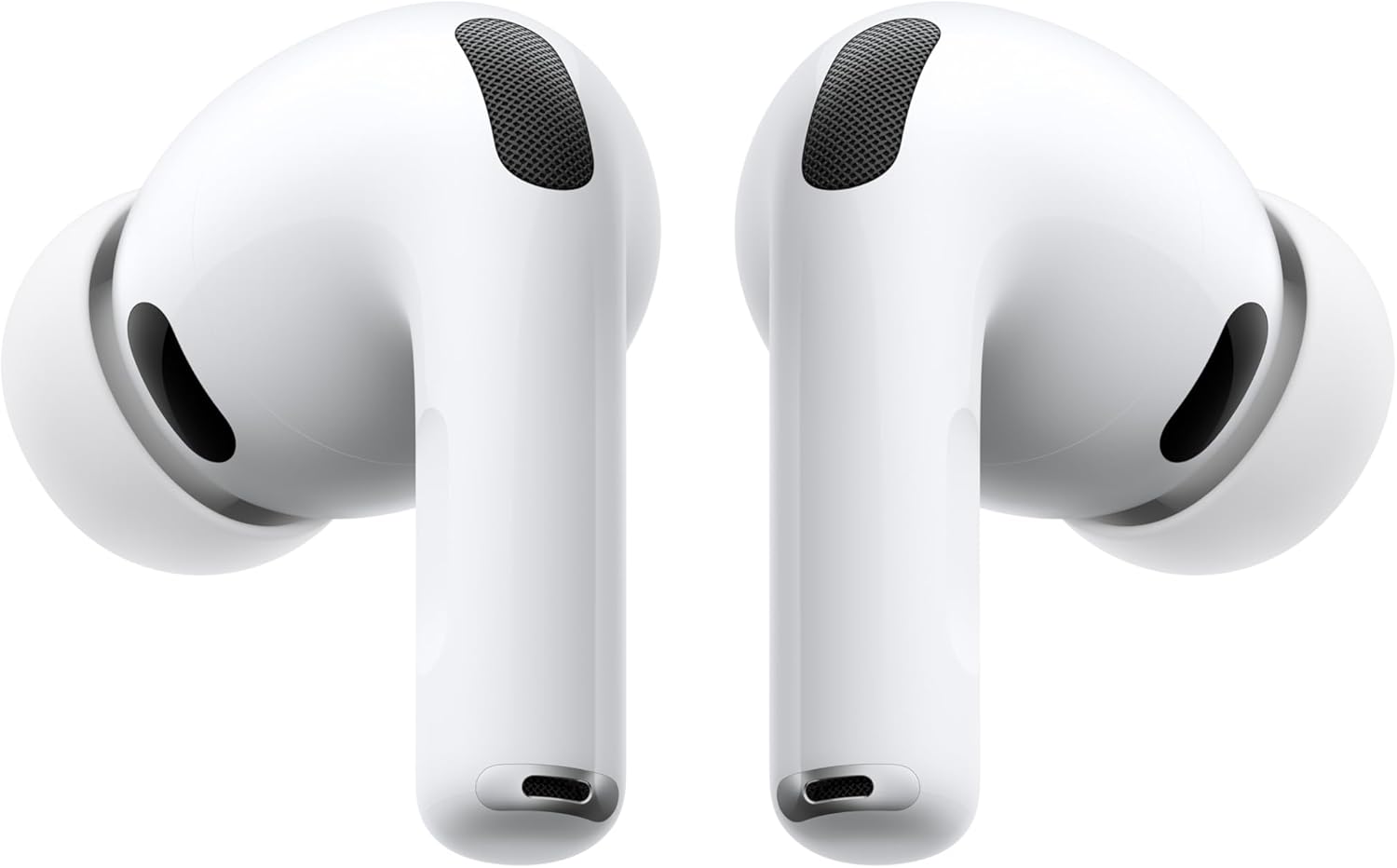
Features include an adaptive active noise cancellation system that adjusts to your ears’ unique shapes in real time, an Apple H2 chip, a total of twenty-four to thirty hours of playback duration (eight hours with ANC and up to ten in Hearing Aid mode), Bluetooth 5.3, an IP57 rating, a heart-rate sensor, a hearing-aid mode that has been cleared by the FDA, spatial audio with head tracking, USB-C, MagSafe, and Qi.
If you own an iPhone, you need the AirPods Pro 3. The H2 chip allows for smooth device switching and rapid pairing. Adaptive ANC does real-time calibration adjustments. For mild to moderate hearing loss, the FDA-approved hearing-aid mode can be helpful. Using head tracking with spatial audio creates an immersive experience. IP57 covers both dust and water.
Unless you’re deeply immersed in Apple’s ecosystem, you really shouldn’t spend on this. Features like hearing aid compatibility, easy switching, and Spatial Audio head tracking are unavailable to Android users. Not the finest in class, but XM5 has a longer runtime. Spend money on things you won’t utilize if health tracking isn’t important to you.
Those who have a hearing aid and use an iPhone, iPad, or Mac and are looking for the most seamless integration and ANC possible. WHO IT’S NOT FOR: People who primarily use Android, those on a tight budget, and those who require extremely long battery life.
8. Sony WF-1000XM5 Truly Wireless Earbuds

Industry-leading ANC with QN2e processor, 8.4-millimeter Dynamic Driver X, eight hours with ANC or twelve without and twenty-four total, Bluetooth 5.3, LDAC Hi-Res up to 990 kbps, IPX4, six mics with AI wind reduction, Speak-to-Chat, Adaptive Sound Control, 360 Reality Audio, DSEE Extreme.
The XM5 delivers industry-leading active noise canceling. Sony’s QN2e processor crushes plane engine drone, subway rumble, and office chatter. LDAC at 990 kbps means high-res Android listeners hear tighter bass and cleaner highs. Six-mic array with AI makes calls studio-clean in wind. Speak-to-Chat pauses audio when you talk.
Fit is variable—some love foam tips, others struggle with seal, and poor fit drops ANC performance. Multipoint Bluetooth was buggy on early firmware. While XM5 upgrades XM4, the leap isn’t enormous—if you own XM4, this may not justify two-twenty.
Android users demanding best ANC and LDAC, audiophiles streaming high-res, frequent travelers.buyers needing consistent fit, users requiring rock-solid multipoint, budget shoppers who own XM4.
Things to Consider Before Buying a True Wireless Earbuds:
Buying true wireless earbuds is tempting—no cables, easy pairing, and a pocketable case that keeps them charged. But not all earbuds fit the same ears, lifestyles, or devices. Before you hit “buy,” here are the most important things to consider so you end up with a pair you actually enjoy using every day.
1) Fit and comfort come first
Sound quality doesn’t matter if the earbuds hurt after 20 minutes or keep falling out on walks. Look for multiple ear tip sizes (and ideally different materials like silicone and foam). If you plan to work out, check for a secure fit design and an IP rating for sweat and water resistance (like IPX4 or higher). People with smaller ears may prefer compact buds and lighter housings.
2) Sound signature and EQ options
Many earbuds have a “tuned” sound—some boost bass for pop and EDM, others aim for balanced detail. If you’re picky, choose a model with an app that offers EQ (equalizer) so you can adjust the sound. Also consider whether you want features like spatial audio or high-resolution Bluetooth codecs. Just remember: great tuning beats fancy specs.
3) Active Noise Cancellation (ANC) vs. passive isolation
ANC is a game-changer for commuting and office work, but implementation varies a lot. Strong ANC can reduce engine hum and background chatter, while weaker ANC may only slightly help. If you’re mostly at home or in quiet areas, good passive isolation (a solid seal) might be enough—and sometimes sounds more natural.
4) Battery life—real life, not marketing
Brands often quote “up to” numbers under ideal conditions. In real use, volume level and ANC can cut battery life noticeably. Check both earbud playback time and total case time. For everyday convenience, features like fast charging and wireless charging can matter as much as raw hours.
5) Microphone and call performance
If you take calls, don’t assume all earbuds are equal. Wind handling, background noise reduction, and voice clarity can vary dramatically. Look for reviews that include call samples or real-world testing in noisy streets—not just quiet indoor calls.
6) Controls and everyday usability
Touch controls can be great—or frustrating. Confirm you can adjust volume, toggle ANC, and skip tracks without pulling out your phone. Also check for wear detection (auto pause), multipoint Bluetooth (connect to laptop and phone), and how stable the connection is in crowded areas.
7) App quality and updates
A good companion app can unlock EQ, firmware updates, ear tip fit tests, and customization. A bad app can mean bugs, unreliable pairing, or features that don’t work as advertised. Firmware updates are also important for fixing issues over time.
8) Your budget and value
Price doesn’t always equal quality, but very cheap earbuds often compromise on microphones, latency, and durability. Decide what matters most—ANC, calls, battery, comfort—and buy the best “all-rounder” you can within your budget.
In the end, the best true wireless earbuds are the ones that fit your ears, match your routine, and make listening effortless. Choose based on comfort and daily features first, then sound—and you’ll be far happier with your purchase.
Leave a Reply