
Finding the best tower fans shouldn’t be a struggle when you are melting in the sweltering summer heat. If you are tired of noisy fans that fail to circulate air, you deserve a major cooling upgrade. We tested several models to find quiet performance and sleek designs for your living space. Experience the blissful relief of a refreshing, icy breeze today. Here are our top picks to keep you comfortable.
Contents
- Top 8 Tower Fans:
- 1: LEVOIT Tower Fan 36″
- 2: DREO Tower Fan 36″ (2025)
- 3: DREO Nomad One S
- 4: DREO 42″ Ultra-Quiet
- 5: Lasko High Velocity Tower Fan
- 6: LEVOIT Smart 42″
- 7: Shark TurboBlade Fan
- 8: Dyson Cool AM07
- Things to Consider Before Buying a Tower Fans:
- Bladed vs. Bladeless Airflow Technology
- Assessing Room Dimensions and Placement
- Determining Budget and Energy Efficiency Needs
- Cleaning Procedures for Intake Grills and Filters
- Electrical Safety and Storage Best Practices
- Remote Control and Programmable Timers
- Integrated Air Purification and Ionizer Options
- Summing up
Top 8 Tower Fans:
1: LEVOIT Tower Fan 36″

The LEVOIT subtly reads the room, an activity that most budget fans neglect.Important features include a 36-inch frame, a flow rate of 25 feet per second, a capacity of 1,044 cubic feet per minute, a decibel level of 28 decibels, a 90-degree oscillation angle, five speeds, four settings (all with timers), and no blades.After you set the temperature sensor to a certain point, it will automatically adjust the fan speed.
The 36-inch frame is too short for rooms with high ceilings, the AC motor is less efficient than DC motors in the next tier, and the Auto mode is too slow to respond to changes in temperature.Those who sleep lightly or who sit at a desk all day and prefer a hands-free cooling system will benefit the most from this. Avoid if you’re an energy hoarder or require app-based control.Convenience without breaking the bank.
2: DREO Tower Fan 36″ (2025)

How far does the air really reach is one question that the LEVOIT cannot answer.Features: 36-inch frame, 26 ft/s airflow, 33 ft airflow reach, 28 dB, 90° oscillation, 4 speeds, 3 settings, 8-hour timer, remote control, and sleek build are all important features.The DREO has a real reach advantage in bigger bedrooms, since it can push air 33 feet across the room.You can’t fine-tune your sleep with the four speeds, and the 8-hour timer ends just before morning. There are also just three options, and there is no auto temperature sensor.
Ideal for: consumers seeking a small, portable design with maximum airflow reach. Who it isn’t for: Those looking for a more extended nighttime timer or automated comfort features.This is the most budget-friendly fan with the furthest reach.
3: DREO Nomad One S

At this point, tower fans transform into intelligent household appliances.Noteworthy features include a 36-inch frame, a speed of 25 feet per second, a noise level of 28 decibels, a DC motor with four speeds and modes, WiFi, support for Alexa and Google Home, an 8-hour timer, and a carry handle.With its DC motor and Alexa’s Auto mode, this fan can automatically adjust its cooling to your home’s needs while using less power than Tier 1 fans.
The deal is that the 36-inch frame remains budget-tier height (smarts, not size), the 8-hour timer doesn’t last till morning, and the four speeds aren’t fine-tuned enough for use at night.Applicable to: Those who own smart homes and would like to use voice control without upgrading to Tier Those looking for a full-night timer or very precise speed controls.A smart tower fan that is easiest to use for the average person.
4: DREO 42″ Ultra-Quiet
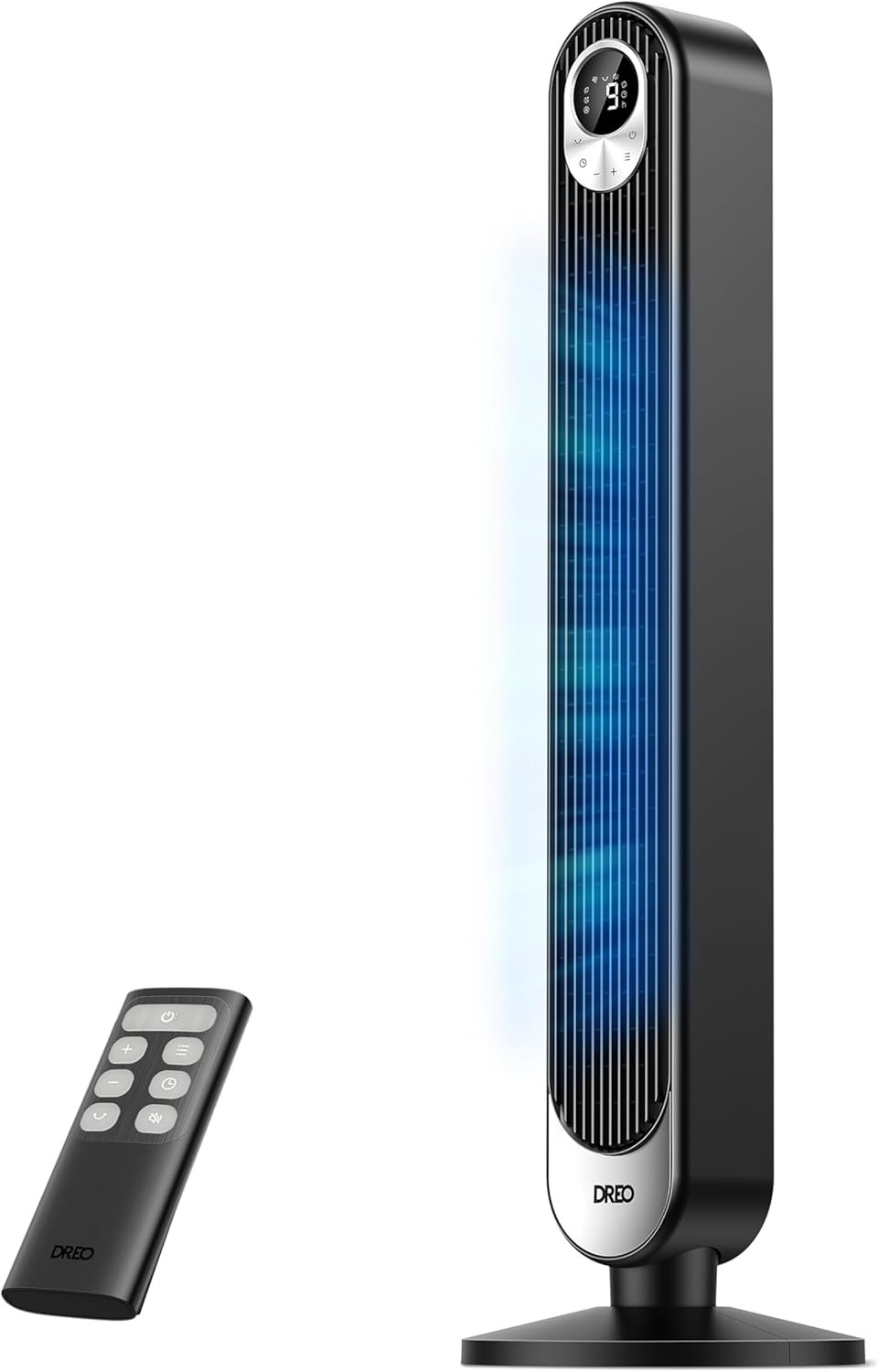
As you rise, the bedroom transforms.Important features include a 42-inch frame, a 28-foot-per-second speed, a 36-foot reach, an ultra-quiet operation at 20 decibels, a 90-degree oscillation, nine speeds, four settings (including Turbo and DC motor), a 12-hour timer, and an auto-dimming display.This fan is the quietest in the video at 20 dB. It has 9 settings, so you can adjust it to your sleep needs with precision.
The negatives are that it can only be operated by remote control and that there is no WiFi or app. Additionally, the Turbo mode is quite loud compared to the lower settings, which makes it useless after 11pm.Who it’s best for: people who have trouble sleeping or who share a bedroom and value quiet. Smart home users need app or voice control will not find this useful.Without a doubt, the most subdued fan on this clip.
5: Lasko High Velocity Tower Fan
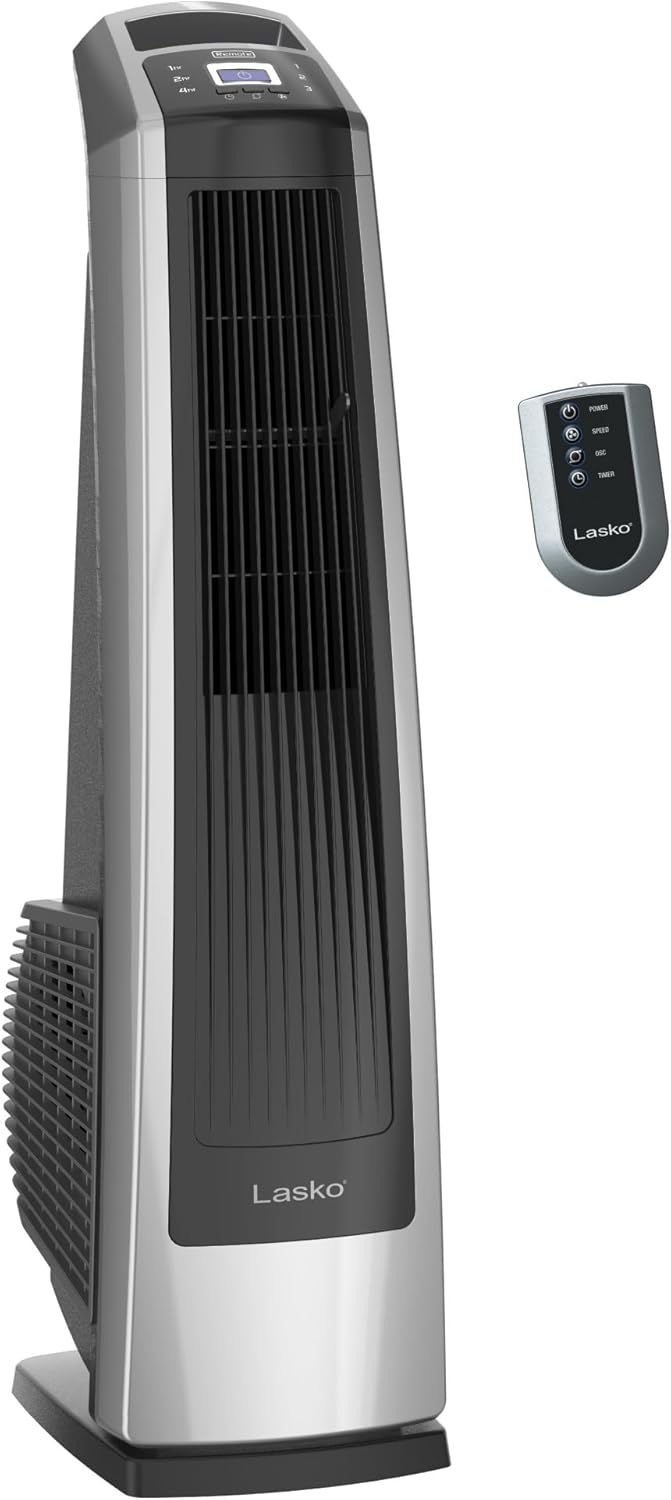
An app isn’t necessary for all buyers. More air, quicker, is all some people require.Notable features include a 35-inch frame, a high-velocity airflow of 509 CFM, three settings, a 90° oscillation, a 7-hour timer, a remote control, certification from ETL, and a Blue Plug safety fuse.Spaces where noise is less important than volume, such as garages, gyms, and big areas that a bedroom fan can’t reach, are ideal for the 509 CFM output.
A smaller fan with three strong speeds and a small profile can fit where a bulkier fan can’t.
Important details: the 7-hour timer lags behind competitors, there is no smart control, no DC motor, and the three speeds do not allow for fine-tuning for sleep.Ideal for: those in need of unfiltered, high-velocity airflow in expansive or functional areas. Do not use if you are a light sleeper or if you require a smart, app-controlled item that is silent.Pure airflow, dependable brand, undivided attention.
6: LEVOIT Smart 42″

The most capable fan available, with twelve speeds and an adjustable wind angle.Key features include a 42-inch screen, 26 feet per second of speed, 25 decibels of noise, 12 speeds, 4 settings, a DC motor, the VeSync app, Alexa, an adjustable up/down wind angle, and a 24-hour timer.
Unlike this fan, which is ideal for use at lower levels (behind a desk or bed), no other model here allows you to change the direction of airflow vertically.
The sleep mode doesn’t turn off, but rather slows down the engine as the night progresses.The downsides include: intermittent connectivity, a lighter-than-expected fan body, and the fact that VeSync has its own app—a second ecosystem if you’re already involved.Customers that value optimal sleep scheduling and accurate speed control. Users of the Dreo ecosystem or those who value high-quality construction should not use this.This video features the tower fan with the most features.
7: Shark TurboBlade Fan

Here, every single fan is pointing in the same direction. You can face it in any way.Features: Bladeless operation, 10 speeds, 10 noise levels, a 180° oscillation, a remote control, and a vertical (Tower Mode) and horizontal (horizontal) pivot.To avoid dead spots in L-shaped rooms caused by fixed oscillation, you can choose between the vertical Tower Mode for directed columns and the horizontal Air Blanket Mode for widespread coverage.In this video, the widest oscillation arc is the 180° sweep.
The facts are: the pivot mechanics make it bulky and awkward to deploy, it lacks WiFi, an app, and HEPA filtration; and contrary to what the marketing claims, Dust Defense is just a particle collection system and not a filter.Open floor plans and L-shaped rooms that require coverage in multiple directions are ideal. Do not purchase if you have a smart home or if you require air purification.This video features the most versatile fan.
8: Dyson Cool AM07

One name comes to mind. You may see if it deserves it here.Features: 10 speed settings, 70° oscillation, a curved magnetic remote control, a 9-hour sleep timer with increments of 15 minutes, and the Dyson Air Multiplier is bladeless.A bladeless ring draws air from all around the Air Multiplier, creating a continuous stream that is unlike any bladed fan in this area.The fan’s magnetic remote stays put on the device.
You pay for Dyson’s engineering and build quality, not the number of specifications—here it falls short: no WiFi, no app, no voice control—only 10 speeds and 70° oscillation trail competitors.Ideal for: households concerned about bladeless safety, especially those with children or pets, and design-conscious consumers. Do not purchase if you are a smart home user or if you are driven by specifications.Find out just what you’re getting if you want to be the most sophisticated fan in this video.
Things to Consider Before Buying a Tower Fans:
Oscillating units distribute air across a wider area, making them suitable for larger rooms or shared spaces. Stationary units, however, focus airflow in a specific direction, ideal for personal use or targeted cooling. Evaluate your space to determine which option best fits your needs.
Bladed vs. Bladeless Airflow Technology
Bladed fans use physical blades to circulate air, generating noticeable airflow and sometimes increased noise. In contrast, bladeless fans harness air pressure to produce smooth, quiet airflow, reducing noise levels and increasing safety. Your choice will depend on your priority for noise and aesthetics.
Bladed fans typically offer a more traditional cooling experience with powerful airflow. If noise and space-safety are your concerns, bladeless technology might be the better choice, providing a sleek aesthetic and quieter operation. Understanding these differences can help you make the right decision based on your lifestyle and environment.
Assessing Room Dimensions and Placement
Identify your room’s measurements to ensure you select a fan that fits well and provides adequate airflow. Understand both the height and width of the space for optimal fan placement, maximizing comfort and cooling performance.
Determining Budget and Energy Efficiency Needs
Establishing a budget is imperative for filtering your options, but also consider long-term energy efficiency. Select fans that offer a balance of initial cost and lower energy consumption to maximize savings over time.
Analyzing your budget includes looking at potential operating costs. Choosing energy-efficient models can lead to significant savings on electricity bills. Many modern fans come with energy-saving features that reduce consumption, allowing you to enjoy cooling benefits without a hefty price tag.
Cleaning Procedures for Intake Grills and Filters
Wipe down intake grills with a damp cloth to remove dust. Detachable filters should be cleaned monthly, either by vacuuming or washing per manufacturer instructions. Keeping these components clean enhances air quality and efficiency.
Electrical Safety and Storage Best Practices
Ensure safety by frequently inspecting the power cord for fraying or damage. Always unplug the fan during cleaning or when not in use to prevent electrical hazards. Store in a dry place to protect against humidity and potential electrical issues.
Electrical safety should be a priority to avoid hazards. Unplug the fan during maintenance to ensure safe cleaning. Store your tower fan in a cool, dry spot where it won’t face moisture or temperature extremes. Doing so minimizes risks and maintains functionality.
Remote Control and Programmable Timers
Opt for fans equipped with remote control and programmable timers, allowing you to adjust settings without getting up. Timers can help automate cooling cycles, ensuring comfort when you need it most.
Integrated Air Purification and Ionizer Options
Consider fans that include air purification features. Such options work to improve indoor air quality by capturing dust, allergens, and other particles, making your space healthier. Integrated air purification and ionizer options are especially beneficial for those with allergies or sensitivities. Many models combine cooling with filtration systems that effectively reduce airborne pollutants. Some even come with ionizers that charge particles to make them easier to capture, enhancing the air quality in your home while you enjoy the breeze.
Summing up
Summing up, consider factors like size, noise level, features, and energy efficiency before purchasing a tower fan. Assess your space requirements, desired functionalities, and budget constraints to make an informed decision. Evaluate customer reviews for real-world performance insights to ensure you choose a model that meets your specific cooling needs.
Leave a Reply