
Finding the best rooftop cargo boxes is a game-changer for your next family road trip. Are you tired of feeling cramped inside your vehicle with luggage at your feet? Don’t let a lack of storage space ruin your breathtaking adventure. We’ve tested several weather-resistant carriers to help you pack efficiently and stress less. This guide reveals the ultimate equipment to keep your belongings protected on any journey. Let’s explore which models deliver the best results.
Contents
- Top 8 Rooftop Cargo Boxes:
- 1: JEGS Rooftop Cargo Carrier
- 2: Auto Dynasty Heavy Duty Hard Shell
- 3: SportRack Vista XL
- 4: SportRack Horizon SR7016
- 5: Yakima SkyBox NX 18
- 6: Thule Force 3 L
- 7: Yakima SkyBox NX XXL
- 8: Thule Motion 3
- Things to Consider Before Buying a Rooftop Cargo Boxe:
- Hard-Shell vs. Soft-Shell Carriers
- Low-Profile Aerodynamic Models vs. High-Capacity Designs
- Weight Capacity and Vehicle Load Limits
- Material Durability and Weather Resistance
- Advantages of Increased Interior Cabin Space
- Impact on Fuel Efficiency and Vertical Clearance
- Determining Crossbar Compatibility and Spread
- Calculating Rear Hatch Clearance and Front Overhang
- Proper Weight Distribution and Securing the Load
- Maintenance and Off-Season Storage Best Practices
- To wrap up
Top 8 Rooftop Cargo Boxes:
1: JEGS Rooftop Cargo Carrier
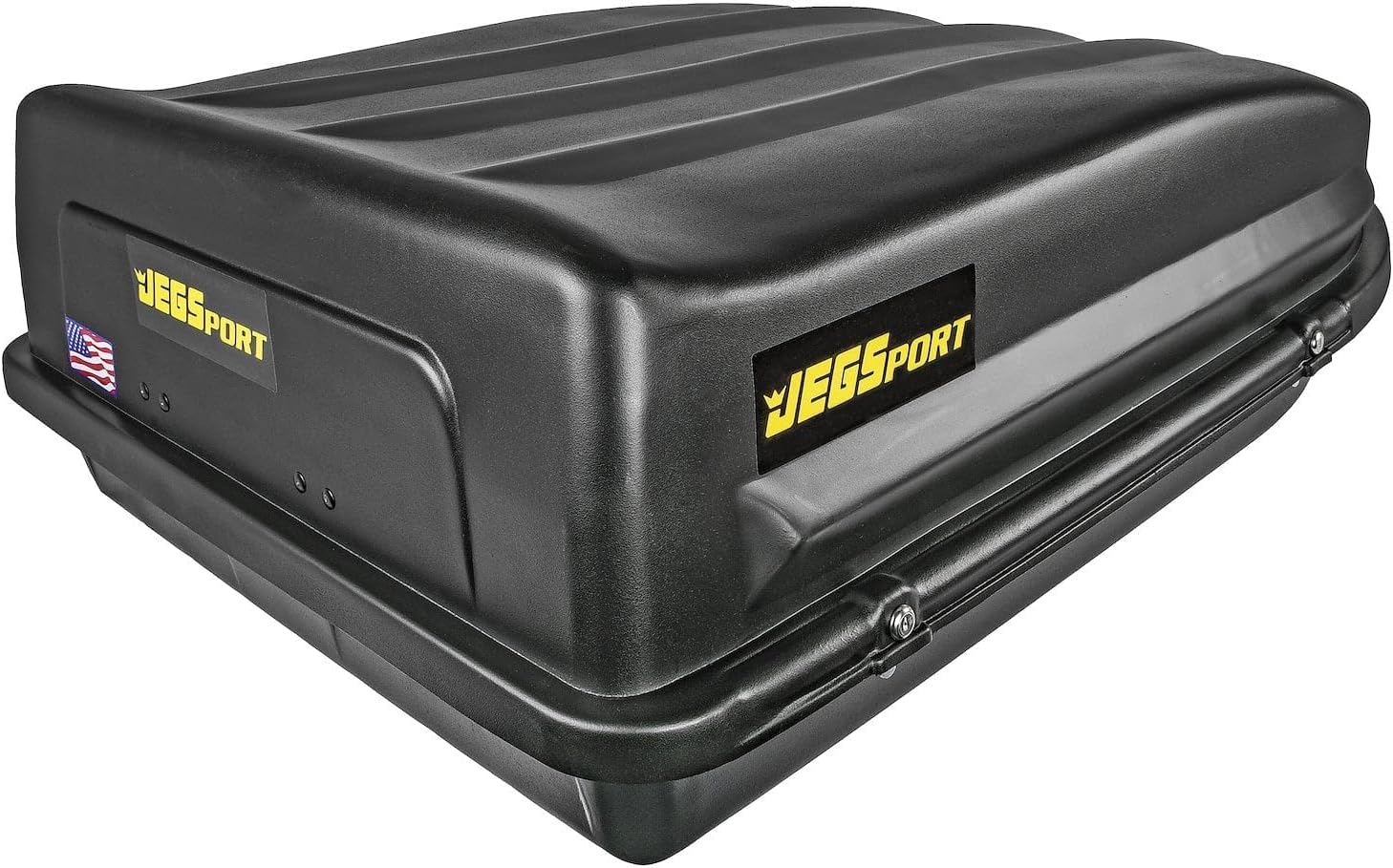
Of all the inexpensive boxes in our series, this one has the best reviews, plus it’s American-made.Features: 18 cubic feet, dimensions (L × W × H), 110-pound capacity, high-density polyethylene (HDPE) material, two-way opening, four-corner lock, and tool-free assembly.The broadest profile available is 38.5 inches, making it perfect for flat loading large objects.In case you were wondering, the 30-day guarantee is the shortest of all the options—so once the first month is over, you’re on your own.
The box is also the shortest, measuring 57 inches, so ski bags won’t fit. And because the crossbar spacing is fixed at 24 inches, you’ll need to check your rack dimensions before placing your purchase.Who it’s best for: frugal families moving big, soft items. Avoid using it for ski excursions or if your rack isn’t normal.Produced in the USA, with the widest reach and the longest history.
2: Auto Dynasty Heavy Duty Hard Shell
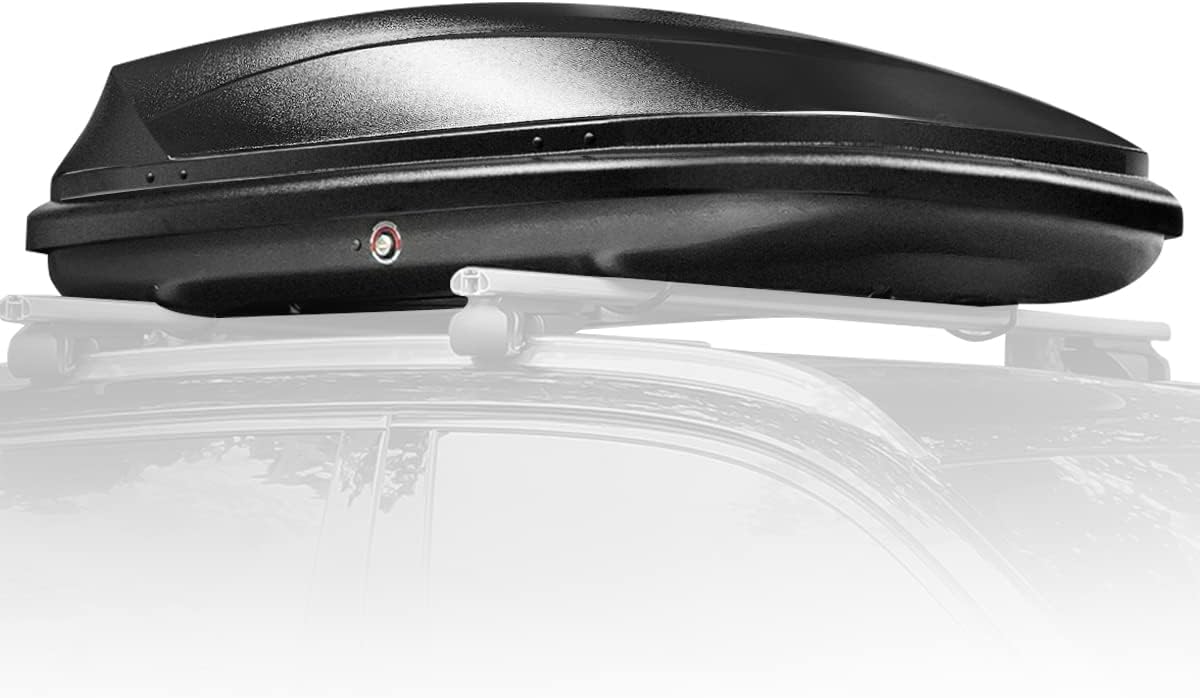
For tiny cars whose stock crossbars are too short to fit the JEGS, there is a solution: the Auto Dynasty.Important measurements: 11 cubic feet, 53″ length, 34″ width, and 15″ height; 110-pound capacity; made of ABS plastic; opens from the side; does not require tools; and compatible with crossbars that are up to 13″ wide.When the rack spread is too narrow, the JEGS won’t fit, but the smaller footprint makes them suitable for such situations.
The facts: for the same price, JEGS offers twice as much space (11 cubic feet), but ABS is softer than HDPE (which JEGS uses), and the brand has a worse reputation in the market.Ideal for: small cars that don’t have enough room for the JEGS footprint. Those who require a large amount of cargo space should not use this.Invest only if the bigger package won’t fit in your car.
3: SportRack Vista XL

The Vista XL has a back opening, which neither of the Tier 1 boxes have.The following are the main specifications: 18 cubic feet, dimensions (L × W × H), weight capacity (110 lbs), resistance to ultraviolet light (UV), rear opening, integrated key lock, and compatibility with square, round, and the majority of factory racks. Finally, it is made of UV-resistant ABS.All of your bulkier camping gear, sleeping bags, and foam cushions will fit straight into that 19-inch profile.
Problems include: a lack of compatibility with the driver’s side in confined spaces due to the rear-opening feature; incompatibility between theJEGS’s HDPE durability and UV-resistant ABS; and, at 63 inches, it falls well short of ski-bag area.Ideal for: families and campers transporting large, floppy stuff. Avoid if you need to reach the driver’s side or are going on a ski vacation.The only rear-opener and the tallest box here.
4: SportRack Horizon SR7016

Equal quality, same label. Constructed to support an entirely new weight.Important details: 16 cubic feet, 75.5″ length, 33″ width, and 16.25″ height; 110-pound capacity; anti-lock brake system (ABS); opening on the passenger side; quick release kit; fittings for 4-6 ski pairs up to 178 cm; or 3-4 snowboards.Skis and snowboards can be safely stored in the longest box available, which measures 75 and a half inches.
On the downside, it has the smallest purchase history of any mid-range selection here, a passenger-side only opening that limits which direction you may approach in a tight lot, and a volume of 16 cubic feet, which is a trade-off for the greater length.Those who seek a specialized ski box are the best candidates for this product. Avoid if you’re a family that values space for cargo or prefers vehicles with two doors.This lineup’s ski box.
5: Yakima SkyBox NX 18

Here we see a shift in classification to the present flagship mid-size from Yakima.Fits skis up to 195 cm, has a dual-side opening, weighs 53 lbs, and has the following important specifications: 18 cu ft, 84″L × 36″W × 16.5 H.With a length of 84 inches, this is the longest reach available; the level floor prevents gear from sliding around. With the SKS system, you only need one key to secure the box and lid to your rack.The RocketBox Pro has been retired, but this new model takes its place.
Yakima is a well-known brand, but the NX series is very young. An empty box weighs 53 pounds, which is more than a loaded mid-range box.Ideal for: groups of all sizes requiring extensive skiing and a high vertical drop. Those looking for more detailed purchase history information should go elsewhere.modern flagship model from Yakima—84 inches, flat floor, two locks.
6: Thule Force 3 L

The lid automatically locks on every shut, which is one feature that sets the Force 3 L apart from everything below it.Important features include an estimated capacity of 16 cubic feet, construction from ASA-ABS plastic, two-way opening, SlideLock, a click for torque indication.The SlideLock system separates locking from opening, allowing the lid to automatically lock when closed. This eliminates the possibility of driving away unlatched. By clicking on a sturdy mount, the torque indicator verifies tightness without the need for tools.
Thule does not disclose the cubic footage, which is approximately 16 cubic feet based on specifications and is less than the SkyBox NX. It is still in the process of establishing a track record since it replaces the Force XT, which is no longer manufactured, and off-listing confirmation is needed for the crossbar spacing.Buyers seeking proof of locking and mounting are the best candidates. Intended use: not for volume maximizers or specifications that have not been confirmed.Confirmed torque, and SlideLock.
7: Yakima SkyBox NX XXL

Choose this container if 18 cu. ft. isn’t quite enough space.Features: 22 cubic feet, ABS plastic, two-way opening, SKS key lock, universal mounting hardware, and it accommodates skis up to 215 cm in length.There’s one box that can hold the complete family’s gear—its maximum capacity is twenty-two cubic feet. Almost all alpine skis, even race-length models, have a 215 cm ski clearance.
The facts are that this is a more current model; Yakima is a well-known brand, but the NX XXL is relatively new; the listing does not include dimensions, which makes crossbar verification more difficult; and if you’re looking for the most advanced mounting experience, the Motion 3 is the way to go.Those with alpine skis longer than 195 cm, big families, or huge camping groups will find this the ideal option. Not for: consumers that value increasing granularity more than capacity.Nothing compares to the 22 cu. ft. capacity king.
8: Thule Motion 3

Of all the boxes here, this one has proven to be the most capable.Important features include an estimated volume of 20 cubic feet, a weight of 60 pounds, ASA-ABS material, a dual-side opening that can be operated with one hand, a mount that supports SlideLock and PowerClick, and a wing-shaped nose.There’s no need for tools or a second inspection because PowerClick verifies mounting with an audible click. In this case, the lowest-drag profile is a wing-shaped nose, which is both more aerodynamic and less noisy when traveling at high speeds.
Let me tell you where it fails: In terms of volume, the Yakima XXL outshines Thule, which does not disclose its cubic footage. However, when it comes to the top of the range, the emphasis is on aerodynamics and ergonomics rather than capacity.This is the best option for those looking for the highest level of aerodynamic refinement. Those looking to maximal volume should look into the Yakima XXL instead.Effortlessly showcase the most exquisite box available.
Things to Consider Before Buying a Rooftop Cargo Boxe:
Buying a rooftop cargo box can enhance your travel experience by providing extra storage. Consider factors such as size, weight capacity, attachment methods, and compatibility with your vehicle to ensure you make a suitable choice that meets your needs.
Hard-Shell vs. Soft-Shell Carriers
Choosing between hard-shell and soft-shell carriers is crucial. Hard-shell designs offer enhanced durability and security, making them ideal for rugged conditions. Conversely, soft-shell carriers provide lightweight convenience and the ability to compress for easier storage.
Low-Profile Aerodynamic Models vs. High-Capacity Designs
Deciding between low-profile aerodynamic models and high-capacity designs influences your travel experience. Low-profile models enhance fuel efficiency and reduce wind resistance, while high-capacity options accommodate larger loads and bulky items.
Low-profile aerodynamic models typically feature sleek designs that minimize drag, promoting better fuel economy over long trips. High-capacity designs excel in offering ample storage for long journeys, making them suitable for family excursions or commercial use. Understanding your specific transportation needs will guide you toward the best choice.
Weight Capacity and Vehicle Load Limits
Each rooftop cargo box comes with specific weight limits. Ensure your vehicle’s recommended roof load does not exceed these limits to avoid safety hazards.
Material Durability and Weather Resistance
Durable materials resist wear and harsh weather. Look for options designed to withstand rain, snow, and UV exposure for longevity.
Materials such as ABS plastic and reinforced fiberglass offer excellent protection against the elements. Choosing a weather-resistant cargo box will prevent damage to items inside and maintain its structural integrity over time. Investing in a quality box not only protects your cargo but also enhances the lifespan of the product.
Advantages of Increased Interior Cabin Space
Freeing up interior cabin space allows for a more comfortable ride, particularly on longer journeys. You can enjoy additional legroom and store personal items without cluttering the seats, improving overall travel experience.
Impact on Fuel Efficiency and Vertical Clearance
Adding a rooftop cargo box can impact your vehicle’s fuel efficiency and height. Increased drag from the box may lead to higher fuel consumption, while the added height requires awareness when navigating underpasses or low bridges.
Fuel efficiency decreases due to the aerodynamic drag created by the cargo box. This additional resistance forces your engine to work harder, thus using more fuel. Height clearance becomes a concern, as not every parking structure or drive-thru can accommodate your vehicle’s altered profile. Planning for these factors ensures a smoother and safer travel experience.
Determining Crossbar Compatibility and Spread
Assessing your crossbar’s compatibility and spread ensures your cargo box fits securely. Measure the distance between the mounting points of your crossbars, which aids in choosing a box that aligns with your vehicle’s specifications.
Calculating Rear Hatch Clearance and Front Overhang
Ensuring sufficient rear hatch clearance and front overhang prevents damage and operational issues. Check the vertical space behind your vehicle’s hatch to confirm that the box won’t obstruct it when opened, alongside measuring how far forward the box extends.
Start by marking the point where the rear hatch opens. This gives a clear idea of how much vertical space exists between the box and the hatch, preventing potential interference. Measure from the front of the cargo box to the windshield to confirm adequate clearance, ensuring safe driving and accessibility to your vehicle’s rear compartment.
Proper Weight Distribution and Securing the Load
Achieving balanced weight distribution in your rooftop cargo box prevents unnecessary strain on your vehicle. Place heavier items on the bottom and distribute weight evenly across the box to maintain vehicle stability. Secure all items with straps or nets to minimize movement during transit.
Maintenance and Off-Season Storage Best Practices
Cleaning and inspecting your cargo box regularly preserves its functionality. Before storing it for the off-season, ensure it’s free of debris and damage, and keep it in a cool, dry place to prevent wear from the elements.
Washing the cargo box with mild soap and water will help maintain its appearance and integrity. Inspect the locks, hinges, and seals for any signs of wear or damage before each use. For off-season storage, consider placing it in a protective cover and storing it indoors if possible, to extend its lifespan and ensure it’s ready for your next adventure.
To wrap up
Drawing together your considerations on purchasing a rooftop cargo box involves evaluating your vehicle’s compatibility, capacity needs, and budget. Prioritize durability and ease of installation for a reliable choice. Assess aerodynamics to optimize fuel efficiency during your travels. Making these informed decisions ensures a convenient and enjoyable journey ahead.
Leave a Reply