
Finding the best portable fish finders shouldn’t feel like a frustrating guessing game when you are on the water. Are you tired of staring at empty screens while trophy catches swim past your boat? Our guide highlights advanced sonar technology that turns every cast into a thrilling victory. Whether you enjoy kayak fishing or bank fishing, these tools ensure you never go home empty-handed. Let’s explore the top gear that will transform your next adventure.
Top 8 Portable Fish Finders:
1: LUCKY Kayak Portable Fish Finder

One of the few wired sonars that can be hull-mounted beneath a kayak, the LUCKY Fish Finder is also the most affordable.Crucial features include a 200kHz sonar, a depth range of 3-328 feet, icons for fish size, a weed and bottom type, a lighted LCD, four AAA batteries, and the option to attach the transducer either hull-down or portable.Useful on flat water below 5 mph, it displays depth, fish icons, and the bottom contour all at once.
What they don’t tell you is that the screen scrambles at speeds over 5 mph, that the four AAA batteries drain quickly when illuminated, and that the fish size symbols are only approximations and not an accurate way to identify the species.Budget kayak fishermen who seek simple depth and fish indicators on flat water will love this. Avoid using it with moving water, motorized setups that exceed idle speed, or GPS systems.What works on the ground level.
2: Venterior Portable Rechargeable Fish Finder
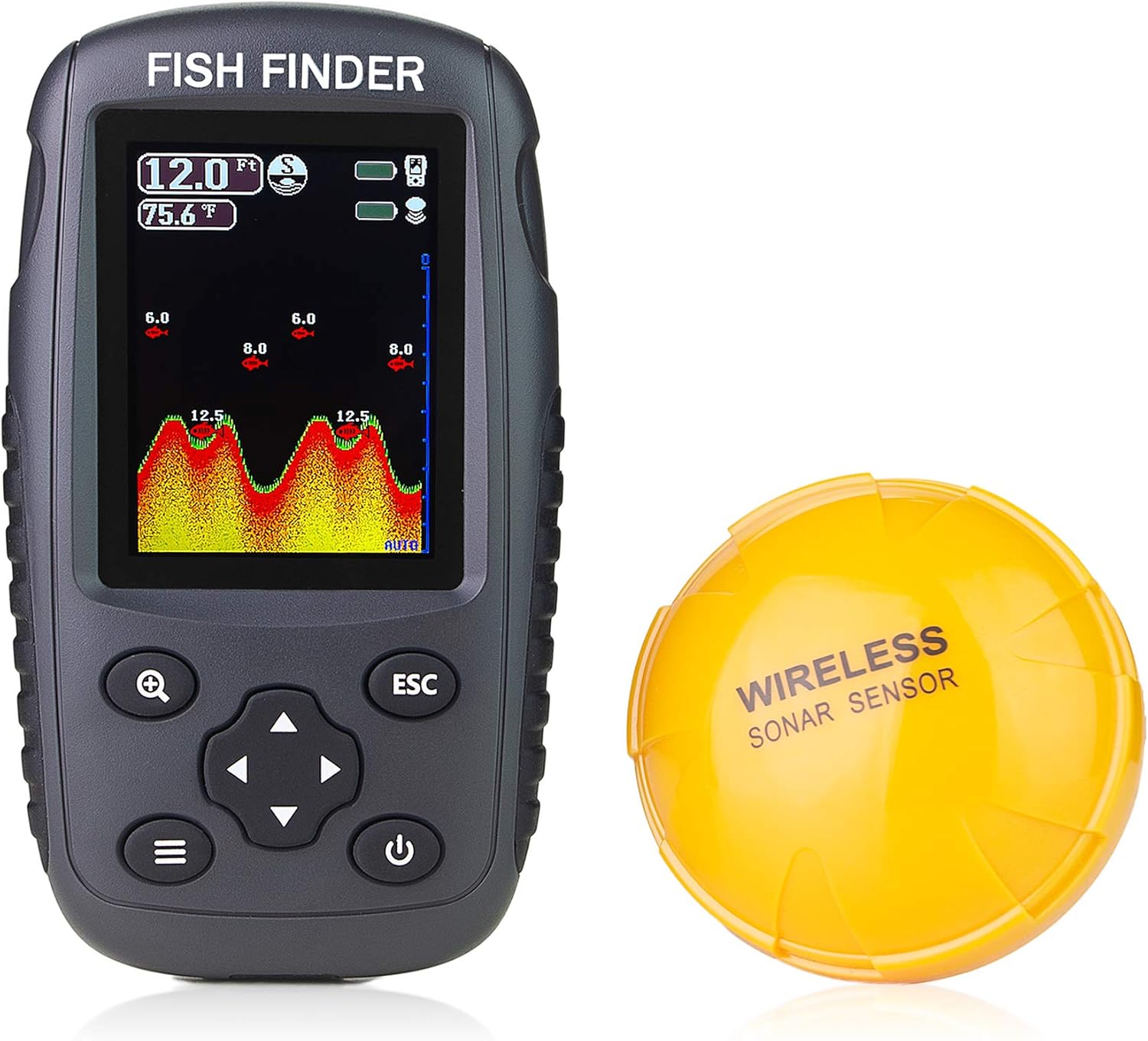
Tier 1 only has the Venterior, a castable sonar that may be tossed from the bow, a dock, or even the shore.Specifications include a wireless castable sensor, a 105-degree beam, a wireless range of 262 feet, a color LCD, the ability to detect water temperature, a rechargeable battery, and the absence of drilling.When scanning drop-offs before paddling in, the wide beam’s ability to interpret structure across a large cone is useful.Color helps fish escape bottom clutter more quickly than monochrome.
In deeper lakes, the 164-foot depth cutout becomes ineffective; fish and bottom blur due to the wide beam’s reduction in resolution; and the lack of a hull mount necessitates recovering the sensor prior to paddling.This wireless no-drill sonar is ideal for dock casters and shore fishermen. Avoid using sonar while underway or in very deep lakes.Surprisingly adaptable.
3: Humminbird PiranhaMAX 4

At this level, the sonar becomes dual-beam and the screen becomes larger.Important features include a 4.3-inch screen, a transom-mounted transducer, dual beam sonar, a waterproof rating of IPX7, a tilt-and-swivel mount, and the absence of GPS.To better read borders and structures, you can switch between the wide and narrow beams, which cover more water horizontally and depth vertically, respectively.
What it doesn’t have: a temperature sensor, a networking connector, a waypoint marking system (so you can find a school but can’t save it), an adjustment to reduce the intensity of the lighting, which would make it easier to see in direct sunlight, and an upgrade path.Kayak fishermen who don’t want to shell out for GPS but still want accurate dual-beam sonar will love this. This is not for you if you require charts or waypoints.Reliable sonar, completely sealed—all you need to know is the GPS ceiling.
4: Garmin Striker Vivid 4cv

The best of the bunch is the Vivid 4cv, which combines GPS, ClearVu down imaging, and Quickdraw mapping into a single device.Features like as a 4-inch color LCD, built-in GPS, Quickdraw Contours mapping, and CHIRP conventional + CHIRP ClearVu scanning sonar are important characteristics.Below the hull, ClearVu provides nearly photographic views; a school of fish log is visible, but the photos are not interpretative.Every contour is mapped out by Quickdraw while you paddle.
There are a few honest trade-offs to consider: the 4-inch screen isn’t big enough for split-screen sonar and maps, it only sees down, and there isn’t Wi-Fi for syncing waypoints.This device is ideal for kayak anglers who desire a combination of mapping, down imaging, and GPS. Not recommended for: fishermen who want a bigger screen or side imaging.The top combo under.
5: Humminbird Helix 5 Chirp GPS G3

Here, the handheld fish finder transforms into a chart plotter with integrated lake charts.Features: 5-inch screen, GPS, AutoChart Live, Dual Spectrum CHIRP sonar, Humminbird Basemap, compatibility with LakeMaster and Navionics charts, G3 generation from 2021.There is no need to download the Basemap because it loads quickly. Using data stored for 8 hours, AutoChart Live creates bespoke contour maps in real-time.The real limitations are as follows: the lack of Down Imaging is due to the fact that it reads sonar returns rather than photographic-style photos; each pane is squeezed into close quarters on the 5-inch display when using split-screen; and chart upgrades, in addition to the preloaded Basemap, cost extra.
Who it’s ideal for: freshwater fishermen who prefer preloaded maps and the ability to design their own contours. Caution: Do not use in seawater or if you are focusing on down imaging.It has the best mapping capabilities of all the models here.
6: Garmin Striker Plus 5cv

With its 5-inch screen and greater depth range than what any kayak need, the Striker Plus 5cv is the way to go.Highlighted features: CHIRP classic + CHIRP, a 5-inch WVGA screen, Featuring a sunlight-readable 2,300-foot depth sensor, built-in GPS, and a ClearVu scanning sonar, this device can map up to 2 million acres.An important improvement is the display’s ability to remain legible even when the sun is directly overhead during midday. With 5 inches of ClearVu, you can see each fish in the water column clearly enough to count them.
Real limitations include the following: unable to use side imaging at this level; inability to sync waypoints or ActiveCaptain due to lack of Wi-Fi; and inability to transfer Quickdraw maps between units.Suitability: kayak anglers seeking Displays ClearVu down imaging in direct sunshine. Avoid using it for wireless communication or side imaging.A larger, brighter display of all the Vivid 4cv offers.
7: Garmin Striker Vivid 7cv

Among these kayaks, the Striker Vivid 7cv has the biggest display at seven inches, featuring color sonar and GPS.Important features include a 7-inch color LCD, CHIRP conventional and CHIRP ClearVu scanning sonar, an integrated GPS system, Quickdraw Contours mapping, Wi-Fi connectivity and the ActiveCaptain software, a GT20-TM transducer, and a tilt/swivel bracket.You won’t have to strain your eyes to see the map or sonar on the 7-inch screen. In between uses, Wi-Fi will sync your phone’s waypoints.
Contradiction: Tier 4 does not have any side imaging, yet mounting a 7-inch screen on a kayak is more difficult than smaller devices.This device is ideal for anglers who desire a large display with GPS and down imaging capabilities. Avoid using it with tiny mounts or side imaging.Fantastic screen, but, there is no side imaging at this level, which truly limits your viewing options.
8: Humminbird Helix 7 Chirp SI GPS G4

You get side imaging, down imaging, and preloaded maps all in one 7-inch gadget with the Helix 7, which is Humminbird’s solution.Notable features include a 7-inch screen, CHIRP Side Imaging and Down Imaging capabilities, Dual Spectrum CHIRP sonar, an integrated GPS system,Humminbird Basemap, AutoChart Live, compatibility with LakeMaster and Navionics, and it is of the G4 generation.Instead of having to start from scratch, the Basemap loads in an instant, and there are already 10,000 lakes there. When conventional sonar fails to detect a vessel, side imaging can fill in the gaps.
No Wi-Fi, no app synchronization. That’s the truth about the limitations.Who it’s best for: fishermen who want the 7-inch side imaging and Humminbird’s preloaded maps. Buyers requiring wireless connectivity or robust review support should not purchase this item.Garmin requires you to construct your own maps, but they come preloaded.
Things to Consider Before Buying a Portable Fish Finder:
Over your fishing experiences, you may find a portable fish finder vital for enhancing your success on the water. This guide outlines key features and considerations to help you choose the right model for your needs.
Castable Wireless Sonar for Shore Anglers
Castable wireless sonar models are designed for shore anglers looking for portability. These devices allow you to cast your sonar into the water and receive real-time data on fish activity directly to your smartphone.
Handheld and Mountable Units for Small Craft
Handheld and mountable units fit perfectly onto small fishing vessels. Both types offer convenience and crucial sonar features for anglers on the go.
Handheld and mountable units provide versatility for small craft fishermen. These devices often come loaded with display features, allowing easy monitoring while navigating tight spaces. They can be mounted securely on kayaks or small boats, ensuring they remain accessible during your outing. Battery life is generally optimized for longer use, making them reliable companions for those focused on catching fish efficiently.
Advantages in Versatility and Setup Speed
Portability allows you to easily switch locations based on fishing conditions. Quick setups enable you to spend more time fishing rather than assembling equipment. These features make portable fish finders favored by casual anglers and avid fishermen alike.
Limitations in Deep Water and Battery Endurance
Battery life can be insufficient for extended trips, often requiring frequent recharges or replacements. Additionally, deeper waters may reveal limitations in the sonar technology, resulting in less reliable readings.
In deeper waters, many portable fish finders struggle to provide accurate data, particularly beyond a certain depth. As these devices typically utilize smaller transducers, their sonar range may not penetrate effectively. This limitation can result in missed opportunities when targeting specific species that dwell in deeper habitats, hindering your overall fishing experience.
Mounting the Transducer for Optimal Signal
Attach the transducer to ensure it is submerged and facing downward for the best signal. Proper positioning can significantly affect depth readings and sonar effectiveness.
Configuring Sensitivity and Depth Alarms
Adjust the sensitivity settings to suit your fishing conditions. Depth alarms can be set to notify you when reaching certain depths, helping you to monitor your fishing environment.
Setting the sensitivity too high can result in cluttered images, while too low may miss important details. Experiment with these settings based on water conditions and target fish species to find the optimal balance for your needs. Depth alarms help you stay aware of sudden changes, enhancing your fishing strategy.
Final Words
Now that you understand key factors like sonar technology, portability, battery life, and features, you can make an informed decision when selecting a portable fish finder. Assess your specific fishing needs, budget, and intended use to ensure your purchase aligns with your goals.
Leave a Reply