
Finding the best outdoor speakers shouldn’t feel like a chore when you just want to relax. Tired of tinny sound ruining your backyard BBQ? A high-quality backyard sound system transforms your patio into a stunning sonic oasis. Whether you need rugged weatherproof audio or simple Bluetooth connectivity, we’ve found the top picks. Stop settling for mediocre music and start hosting the legendary parties you deserve. Let’s dive into the ultimate gear for your space.
Contents
- Top 8 Outdoor Speakers:
- 1: Tribit StormBox Micro 2
- 2: JBL Clip 5
- 3: Soundcore Boom 2 by Anker
- 4: JBL Flip 7
- 5: Bose SoundLink Flex (2nd Gen)
- 6: Soundcore Boom 2 Plus
- 7: JBL Xtreme 4
- 8: Bose SoundLink Max
- Things to Consider Before Buying a Outdoor Speaker:
- Permanent In-Ground and Landscape Models
- Wall-Mounted Architectural Speakers
- Weather Resistance and IP Ratings
- Power Output and Sound Dispersion
- Connectivity Range and Signal Stability
- Benefits of High-Fidelity Outdoor Sound
- Limitations of Environmental Acoustics and Installation
- Mapping the Coverage Area and Listening Zones
- Determining Power Source and Wiring Requirements
- Initial Configuration and Hardware Mounting
- Strategic Placement for Balanced Soundscapes
- Minimizing Environmental Noise Interference
- Integration with Smart Home Ecosystems
- Seasonal Cleaning and Care Protocols
- Shielding Equipment from Extreme Weather
- Conclusion
Top 8 Outdoor Speakers:
1: Tribit StormBox Micro 2

Attached to your bike, backpack, or belt loop, this small speaker produces 90 dB sound from an object as small as a hand. Impressive features include a 10-watt XBass DSP, a 12-hour battery life, and Bluetooth 5.3. When you hear the bass depth for the first time, you’ll be shocked because it surpasses most speakers of this size.What they leave out is this: Always be wary about relying on your phone’s charging capabilities. Once the volume exceeds 80%, the sound becomes muted. Pressing buttons takes a long time.
Ideal for: Cyclists and hikers that require a durable clip-on. This is not the place for loud backyard parties.When it comes to small speakers, nothing beats the sonic quality of the StormBox Micro 2.
2: JBL Clip 5

The Clip 5 is similar to the Tribit in that it fastens to a variety of surfaces by means of a wide carabiner, such as towel rods, shower heads, bike handles, and backpack clips. Features: 5-band equalization, 12-hour battery life, Bluetooth 5.3 Auracast, and IP67 water resistance. At outdoor volumes, the sound is balanced and powerful, with good bottom.
As a sobering reminder, not a single unit supports stereo. Bass is muted by Playtime Boost; it works well for audiobooks but not music. Not compatible with previous versions of the JBL PartyBoost speaker bridge.Who it’s best for: Gen Xers looking to connect to the JBL environment.Avoid: Phone charging or audio with a lot of bass.The Clip 5 is an easy-to-use hook-on speaker.
3: Soundcore Boom 2 by Anker

This is no place for a party speaker with 80 watts, a floating design, and a real-world battery life of 24 hours. Important features include an 80W BassUp 2.0, a 24-hour battery life, a floatable design (IPX7), PartyCast 2.0 support for up to 100 speakers, and an LED light show. Without making a dent, it filled an outdoor basketball court.Now here’s the rub: Lacking a dustproof rating, it is safe to use in pools but poses a concern when left unattended at beaches. Sound bar controller (SBC) alone in a Bluetooth headset reduces speaker fidelity. When the volume exceeds 70%, the mids and highs get crowded.
Ideal for: Long days at the lake or pool that require a marathon battery. Sandy beaches and balanced audio are not ideal.Nothing in this class compares to it in terms of raw battery power and bass production.
4: JBL Flip 7

The Flip 7 is the most versatile and durable speaker on this list, excelling in every area where the Boom 2 excels. The following are some of the most important specifications: 14 hours of battery life, 7-band equalization, AI Sound Boost, Bluetooth 5.4 Auracast, and water resistance (IP68). It is prepared for any outside situation thanks to its IP68 rating and drop-proof construction.One drawback is that the battery life is less than 14 hours while using high levels. V-shaped tuning naturally produces thin vocals; adjust the equalizer accordingly. Prevents older JBL speakers from pairing by removing PartyBoost.
The ideal choice for adventurers who require extreme protection from water and drops. Not suitable for JBL homes that are hoping to pair with legacy PartyBoost systems.When it comes to portable speakers, the Flip 7 has more features than any other model.
5: Bose SoundLink Flex (2nd Gen)

Personally, I prefer this one. Reason being, no other speaker here possesses the technology known as PositionIQ. Notable features include three-band equalization, stereo sound, a 12-hour battery life, aptX adaptive, Bluetooth 5.3 multipoint, and an IP67 waterproof and floatable rating. If your device is flat, upright, or hanging, PositionIQ will automatically recognize its orientation and adapt the audio to sound perfect. Superior to competing systems, the sound is both well-balanced and intricate.
Important information: the shortest battery life in this category is twelve hours. The USB-C port is solely for charging purposes; it does not support connected audio. Compared to the SoundLink Max, Soundstage has a slimmer layout.Ideal for: People who value high-quality sound on a daily basis. Do not use for: Events that last all day and require a low battery.If you’re looking for a robust device with balanced and refined sound, this is it.
6: Soundcore Boom 2 Plus
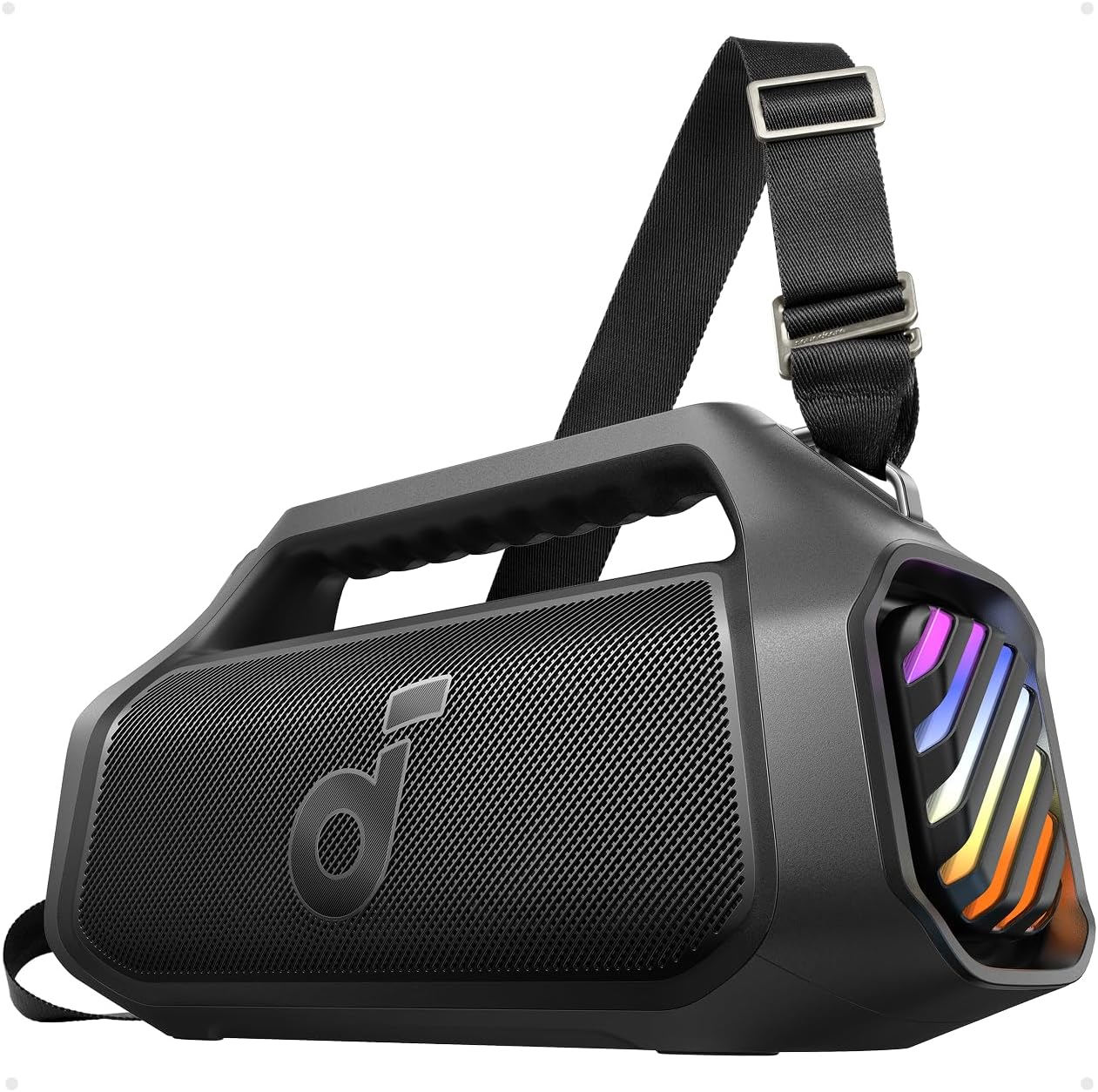
The Flex focuses on audio, while the Boom 2 Plus boasts 140 watts of power, a floating boombox design, and an integrated light display. The 140W BassUp 2.0, together with the dual 4.5-inch woofers and tweeters, a 20-hour battery life, a 10-band equalization, and a 3.5mm AUX port, are noteworthy specifications. When you turn on BassUp, this speaker will really flow water around it, making it perfect for outdoor parties.
One drawback is that it is not dustproof, thus it is just as susceptible to sand as the regular Boom 2. Carrying 8.4 pounds is a lot of work. The LED light show isn’t really rhythmic.When substantial volume is required, such at a pool party or a nocturnal garden gathering, this is the way to go. Avoid areas with sandy beaches, hikes, or high-quality audio.Exceptional bass response and low cost compared to high-end party speakers.
7: JBL Xtreme 4

The Xtreme 4 revolutionizes long-distance travel with its removable battery, making it the first portable speaker with this feature. Important features include a 70W battery, a 100W AC adapter, IP67 water resistance, a 24-hour detachable battery, a 2-hour runtime on a 10-minute charge, 2 hours of playback on a 5-band equalizer, and a bottle-opener strap. Even when pushed forcefully, the sound remains balanced and controlled, which is a pleasant surprise.
This is where it fails: Reduced output from 100W to 70W when powered off AC is noticeable at loud volumes. It is not possible to preserve and disable EQ presets while pairing. Xtreme 3 via PartyBoost is incompatible with older versions.The ideal scenario is a multi-day journey where you’ll need a spare battery to last the entire weekend. Homeowners looking to PartyBoost or those seeking a more refined sound should not purchase this.No outdoor gathering is complete without the Xtreme 4.
8: Bose SoundLink Max

True stereo imaging, or the ability to separate the sound to the left and right from within a single speaker, is only available on the SoundLink Max.Impressive features include a 20-hour battery life, aptX Adaptive + 3.5mm AUX, Bluetooth 5.3 multipoint, 3-band equalization, and a USB-C power bank. Above all else, stereo imagery opens up a far larger soundstage. The 20-hour claim is consistently met by the battery.The veracious reality: Needs a PD charger, which isn’t supplied and is sometimes too sluggish for many sockets. When not in use, the battery slowly drains.
Tuned for quality, not volume, sound becomes distorted at levels above 70%.Audience members that prioritize depth of field over loudness would love this. Avoid: Those who host really noisy events or who do not own a PD charger.When it comes to sound quality, the SoundLink Max is the clear winner.
Things to Consider Before Buying a Outdoor Speaker:
Portable Bluetooth and wireless units offer flexibility and convenience for outdoor settings. These speakers can be easily moved and paired with your devices, allowing for spontaneous gatherings and music enjoyment anywhere.
Permanent In-Ground and Landscape Models
Permanent in-ground and landscape models blend into your outdoor environment. Typically installed as part of a larger system, they provide consistent sound coverage and enhance the aesthetics of your landscape.
Permanent in-ground options include speakers that integrate into the ground or garden features, providing an immersive audio experience without obstructing views. Landscape models often resemble natural elements, making them less noticeable while still delivering high-quality sound.
Wall-Mounted Architectural Speakers
Wall-mounted architectural speakers are designed for discrete sound distribution in outdoor spaces. These speakers can be integrated into existing structures, providing clear audio without taking up additional space.
Wall-mounted architectural speakers are available in various designs to complement your home’s exterior. They ensure sound is directed to specific areas, making them suitable for patios, decks, and outdoor dining areas.
Weather Resistance and IP Ratings
Choosing speakers with high IP ratings guarantees protection against dust and moisture. Look for ratings like IP65 or higher for outdoor durability, ensuring they withstand rain and humidity while maintaining performance.
Power Output and Sound Dispersion
Power output determines how loud your speakers can get, while sound dispersion affects how evenly the sound fills the space. Aim for speakers that provide both sufficient decibel levels and effective coverage.
Understanding power output helps in selecting the right speaker for your space. High wattage means louder sound, but consider the audio quality as well. Sound dispersion is equally important; speakers should distribute sound evenly across your outdoor area. Choosing those with a wider dispersion angle can enhance the listening experience, filling the environment without dead spots.
Connectivity Range and Signal Stability
Connectivity range is crucial for maintaining a solid signal from your devices. Ensure that your outdoor speaker offers reliable Bluetooth or Wi-Fi capabilities that allow for uninterrupted playback across various distances.
Signal stability plays a key role in preventing interruptions during use. Look for speakers with advanced wireless technology that minimizes interference from other devices. Good signal range ensures you can enjoy music anywhere in your outdoor space without sudden dropouts or connection issues.
Benefits of High-Fidelity Outdoor Sound
Experiencing high-fidelity outdoor sound enhances gatherings, providing a rich audio experience that captures nuanced details. Whether hosting a barbecue or enjoying a quiet evening, quality sound creates an immersive atmosphere that elevates enjoyment. Investing in superior audio systems ensures pleasing sound reproduction, making every moment memorable.
Limitations of Environmental Acoustics and Installation
Environmental factors like ambient noise and weather can significantly impact sound quality outdoors. Additionally, installation challenges, such as limited access to power sources and fluctuating acoustics in open spaces, may hinder optimal performance.
Wind, nearby traffic, and natural barriers can distort sound, making it important to consider your outdoor environment. Choosing the right location for installation can mitigate some challenges, but engineers often recommend professional assessment for best results. Acoustic treatments may also be necessary to address specific sound dispersion issues, complicating the setup further.
Mapping the Coverage Area and Listening Zones
Identifying your coverage area is vital for optimal sound performance. Designate specific zones based on where you plan to gather, ensuring every listening space receives balanced audio. Sketching this layout will help streamline installation.
Determining Power Source and Wiring Requirements
Analyze potential power sources to ensure reliable operation. Decide if using an electrical outlet, battery pack, or solar panel suits your needs. Understanding wiring will help avoid any installation hiccups later on.
Choosing the right power source impacts your setup significantly. Inspect your environment for available outlets or consider extending power lines if necessary. For battery-operated solutions, plan for regular recharging or replacement. Solar options provide a renewable path, but verify sunlight exposure in your area to ensure efficiency.
Initial Configuration and Hardware Mounting
Establish where the speaker will be mounted for optimal sound projection. Secure necessary hardware to ensure stability. Proper configuration helps in achieving both aesthetic appeal and functional audio performance.
Selecting the right mounting hardware enhances durability and sound quality. Use brackets designed for outdoor conditions or consider portable stands for flexibility. Ensuring proper alignment initially can save time and effort during final adjustments, leading to overall better audio output.
Strategic Placement for Balanced Soundscapes
Positioning your outdoor speakers properly enhances sound distribution. Aim for elevated locations, avoiding corners and walls that can distort audio. Spaces between speakers should be uniform to create a balanced sound field throughout your area.
Minimizing Environmental Noise Interference
Identifying sources of external noise is vital for clear sound. Blocking or reducing nearby disturbances improves audio quality significantly. Keeping speakers away from loud areas ensures more enjoyable listening experiences.
Whether it’s traffic, wind, or other outdoor activities, taking steps to minimize these noises can greatly enhance sound clarity. Employing natural barriers, like bushes or fences, can help block unwanted sounds. In some cases, investing in noise-canceling technologies may be worthwhile for a peaceful listening environment.
Integration with Smart Home Ecosystems
Integrating your outdoor speakers with smart home systems provides control and versatility. Applications allow you to manage playlists and volume easily from your smartphone, enhancing user convenience.
Connecting speakers to smart home ecosystems enables synchronized playback across multiple devices. Utilizing voice assistants can further streamline the experience, allowing for hands-free operation. This cohesive integration aligns outdoor audio with your entire home setup, creating an efficient sonic experience.
Seasonal Cleaning and Care Protocols
Implementing seasonal cleaning protocols helps preserve your speaker’s performance. Every few months, dust it off with a soft cloth and clean any dirt or grime using a gentle solution, ensuring the speaker remains free from debris that could affect sound quality.
Shielding Equipment from Extreme Weather
Preventing damage from extreme weather conditions is vital for longevity. When harsh elements strike, consider using covers, bringing the speakers indoors, or investing in weatherproof models designed to withstand the elements more effectively.
Protecting your outdoor speaker from extreme weather involves proactive measures. During storms, heavy rain, or intense sun, store your speaker inside for safety. In less severe conditions, invest in high-quality protective covers that repel moisture and UV rays. Regularly inspecting the speaker for any wear or damage after weather events will also help maintain its functionality over time.
Conclusion
Summing up, consider sound quality, durability, battery life, and compatibility when selecting an outdoor speaker. Be mindful of the environment where you’ll use it, ensuring it withstands weather conditions. Think about portability and whether the design suits your style. Careful evaluation leads to a more satisfying audio experience outdoors.
Leave a Reply