
Choosing the best home security cameras shouldn’t feel like a stressful chore. You deserve to protect your family and gain total peace of mind without overspending on complex systems. Whether you need a smart doorbell or wireless surveillance, we have you covered. This guide cuts through the clutter to highlight reliable options that keep your loved ones safe. Experience the incredible relief of a secure home today. Let’s explore our top-rated picks for your property.
Contents
- Top 8 Home Security Cameras:
- 1: WYZE Cam v4
- 2: Tapo C325WB
- 3: Blink Outdoor 4
- 4: Google Nest Cam Indoor (Wired, 3rd Gen)
- 5: eufy Security SoloCam S340
- 6: REOLINK Argus PT Ultra + Solar Panel
- 7: eufy Security eufyCam S4
- 8: Google Nest Cam with Floodlight (Wired)
- Things to Consider Before Buying a Home Security Camera:
- Indoor and Outdoor Build Variations
- Wired versus Wire-Free Power Solutions
- Resolution and Field of View Requirements
- Night Vision and Motion Detection Capabilities
- Local Storage and Physical Recorders
- Cloud-Based Services and Subscription Models
- Mapping High-Traffic Entry Points
- Optimizing Camera Height and Mounting Angles
- Smart Home and Mobile App Compatibility
- Privacy Settings and Cybersecurity Protocols
- Conclusion
Top 8 Home Security Cameras:
1: WYZE Cam v4

With its 2.5K resolution and full color night vision, the Wyze Cam v4 easily outshines its competitors in this category.Crucial features include: Wi-Fi 6, 2.5K QHD, IP65, starlight color night vision, and microSD support up to 512GB.Artificial intelligence tracking tracks persons throughout large outdoor areas, local recording is free of charge, and no floodlight is required.
Unbeknownst to them, there is a five-minute rest period and a limit of one still image (not a video) per event under the free plan. During a privacy incident in 2024, certain users had temporary access to the footage of other users. Not compatible with Apple HomeKit.Outdoor and porch surveillance is where it’s at.Indoor use or homes with HomeKit are not compatible.Impressive number of cameras. Put it in the yard.
2: Tapo C325WB

Night vision without a spotlight is possible with the Tapo C325WB, an ability that cameras with far higher prices have trouble matching.The following are the main specifications: 2K QHD (2688×1520), an F1.0 super-aperture lens, an IP66 rating, a 127° field of view, and the option to connect by Ethernet or Wi-Fi.The F1.0 lens is capable of capturing full-color nighttime film using only ambient light, which is four times more light than a typical F2.0 lens. There is no cost whatsoever for the detection of people, animals, and vehicles.
The reality check: there is no automatic toggle for HDR; you have to disable it manually at night. Mounting requires finishing the Wi-Fi configuration indoors because it is picky. It is not advisable to use it indoors.Ideal for: daytime color night vision in the outdoors without the need for a floodlight or membership.Indoor setups or homes with HomeKit are not compatible.Quite simply, the finest camera available for the money.
3: Blink Outdoor 4

With two AA lithium batteries, the Blink Outdoor 4 promises two years of runtime, which it more than meets in areas with little foot activity.Notable features include two-way audio, 143° field of view, two-year battery life, and 1080p at 30 frames per second.The smooth interaction with Alexa and the wide field of view are two really handy features.The catch is that there is no USB connector on the bundled Sync Module Core, therefore there is no local storage available, either for a fee or not at all. You can’t watch any of the recorded film unless you pay for a cloud membership.
Night vision only works in infrared, and it loses all detail after twelve feet. A subscription is necessary for person detection.This outdoor security system is ideal for Alexa homes that prefer a cordless setup.Please do not purchase if you are anticipating color night vision or local storage.Installs easily; before you buy, make sure you know what you’re buying.
4: Google Nest Cam Indoor (Wired, 3rd Gen)

In terms of picture quality, the Nest Cam Indoor is head and shoulders above the competition in 2026.Specs to note: two-way audio, dual-band Wi-Fi (2.4/5GHz), 152° field of view, 2K HDR (2560×1440) at 30 frames per second, Gemini AI.Gemini AI allows you to search your video history with plain-language queries, and the 152° FOV covers a full room from a corner. The processing on this sensor from Google is outstanding.One drawback is that there is absolutely no local storage; all data is sent to Google’s cloud instantly. The free tier is limited to three hours. A monthly subscription is needed for full functioning. No outside use.
That it’s best for: Google Home users that value top-notch indoor picture quality.Not recommended for those who value their privacy or who require coverage when outdoors.Incredibly high-quality images, but you’ll have to shell up some cash per month to access them all.If you’re finding this helpful, please like and comment with your setup details (whether it’s indoors, outdoors, wired, or wireless). All comments are responded to.
5: eufy Security SoloCam S340

And that’s it. An opinion I hold. Equipped with solar power, 360° pan-tilt, dual-lens optical zoom, and no subscription fees—the eufy SoloCam S340 is a wireless camera that packs a punch.Notable features include a 2.2W solar panel, 8 GB of storage, a 360° pan and 70° tilt, and a 3K wide-angle and 2K telephoto dual lens.At a distance of 30–40 feet, the optical telephoto can read license plates. In most regions, the solar panel can hold a full charge without requiring maintenance. The tracking feature of AI activates itself.
You should realize that 8 GB only keeps enough data for a few days—to store long-term data, you should install a HomeBase 3. This battery won’t last all day long playing recordings. Climates with a lot of shade reduce solar performance.Ideal for: no monthly payments, optical zoom, and wire-free coverage.For houses in partial shadow or those who want round-the-clock recording, this feature is not suitable.
Really, just one camera can do the work of two.
6: REOLINK Argus PT Ultra + Solar Panel

You give up optical zoom for real 4K resolution and Wi-Fi 6 reliability, but the pricing is the same as the Eufy.Salient features: solar panel integrated, 4K 8MP (3840×2160), 355° pan / 140° tilt, dual-band Wi-Fi 6, IP65, microSD up to 512GB.Even at great distances, the 4K sensor produces remarkably clear images of faces and plates. Compared to single-band competitors, Wi-Fi 6 maintains a more stable signal at the same distance.
Fast people may slip out of frame before recording begins since PIR triggers three to five seconds after motion. Zooming is done digitally exclusively; optical telephoto is not here. As the temperature descends below freezing, solar charging plummets.4K resolution and scalable local storage are the best options.Do not purchase if you require close-up optical zoom or if you live in a cold climate.This tier’s most lucid image.
7: eufy Security eufyCam S4
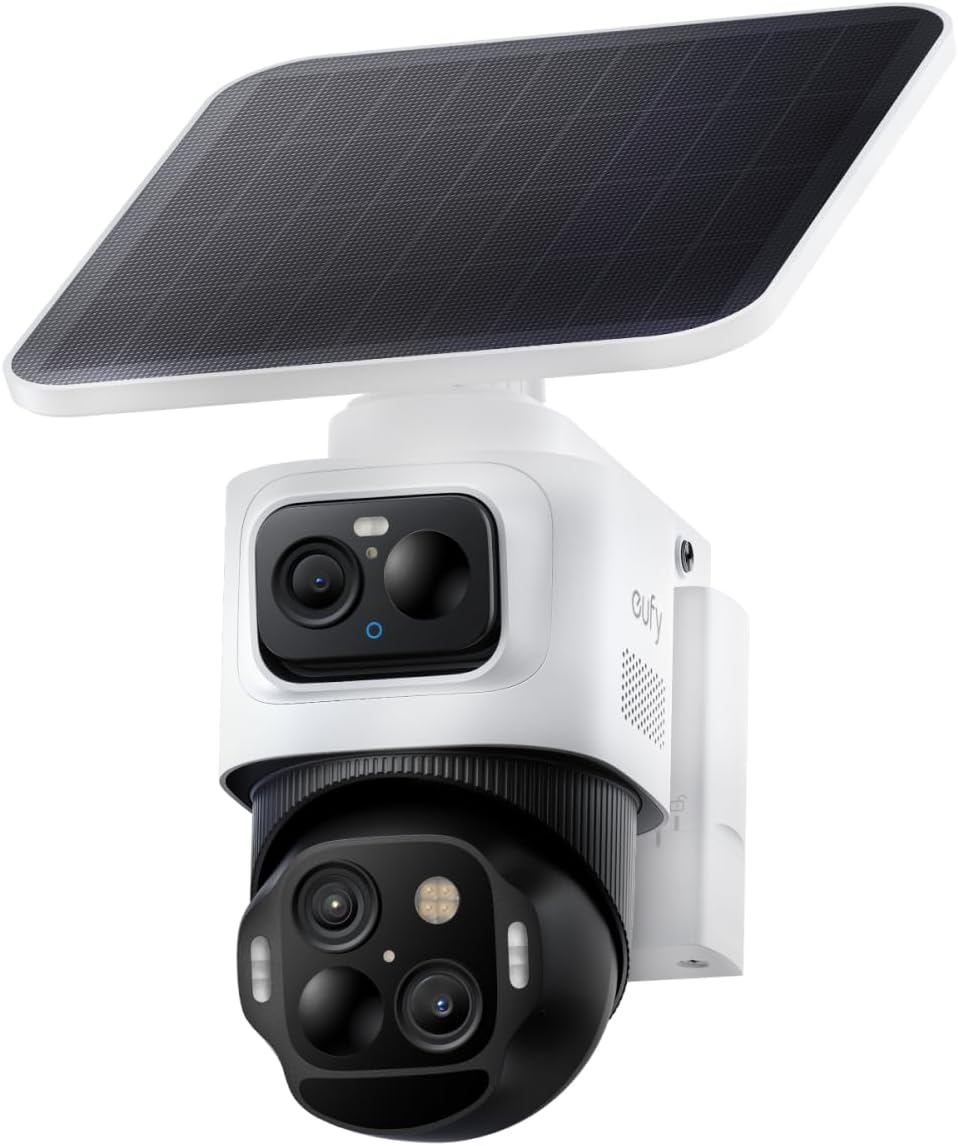
Running in tandem, the eufyCam S4’s motorized 2K PTZ and fixed 4K bullet lens ensure that tracking will never compromise your front-facing vision.Features: 4K fixed bullet with 130° field of view and 2K dual-lens PTZ with 360° pan and 70° tilt; 8x hybrid zoom; dual radar and PIR sensors; 10,000mAh battery; 5.5W solar power; 32GB of storage; and two radar and PIR sensors.In less than a second after the bullet senses movement, the PTZ locks on. Combined, radar and PIR can eliminate wind and shadow-related false alarms.
The problem is that its body is big and noticeable. The additional HomeBase S380 is needed for facial recognition, which increases the overall cost. In dual-view mode, the 4K feed is downscaled.Maximizes coverage and accuracy with auto-tracking capabilities.Neither Apple HomeKit nor covert installations are suitable for this.Here is the most inventive camera.
8: Google Nest Cam with Floodlight (Wired)

The most expensive model in this lineup can capture 1080p video. Year 2026. That is the truthful foundation.Features include a 130° field of view, 2400-lumen dual LED floodlights, an IP54 rating, a 180° floodlight sensor, and 1080p HDR at 30 frames per second. Hardwired installation is necessary.Impressively, the 2400-lumen floodlights activate color night vision and light up a whole driveway. There is no hiccup when using Gemini with Google Home.
Hardwired installations necessitate an existing junction box, which in turn necessitates the services of an electrician if no box is present. Limited to three hours of free cloud storage, no local storage available. IP54 isn’t as strong as its rivals. Plus, 1080p isn’t very defendable at this level.Households using Google Nest and wanting to integrate strong floodlights with existing wiring are the best candidates.Avoid if you don’t have the necessary wiring or if you’re looking for a resolution of 2K or higher.An enormous spot light. The camera is old.
Things to Consider Before Buying a Home Security Camera:
Camera choice can greatly influence your home security strategy. Understanding your specific needs, features, and installation options is imperative for making an informed purchase. This guide outlines important factors to consider, ensuring you find the right surveillance solution for your home.
Indoor and Outdoor Build Variations
Choosing between indoor and outdoor cameras hinges on build quality. Indoor cameras often focus on aesthetics, while outdoor options require weatherproofing and durability. Consider your specific environment for optimal effectiveness.
Wired versus Wire-Free Power Solutions
Assessing wired and wire-free systems depends on your installation preferences. Wired cameras offer consistent power but require more effort to set up, whereas wire-free options simplify installation and add flexibility.
Wired systems generally provide uninterrupted power, ensuring consistent performance. They are ideal for permanent setups, particularly in areas with reliable electricity. Wire-free cameras, however, deliver ease of installation and can be positioned conveniently, making them suitable for renters or temporary placements. The choice ultimately impacts long-term maintenance and camera utility.
Resolution and Field of View Requirements
Resolution affects image clarity, determining how identifiable people and objects are in the footage. A wider field of view allows more area to be monitored, which is especially useful for larger properties. Select cameras with at least 1080p resolution for clear images.
Night Vision and Motion Detection Capabilities
Quality night vision ensures functionality after dark, while active motion detection alerts you to potential intruders. Look for cameras with infrared capabilities and customizable motion zones to reduce false alarms.
Effective night vision typically utilizes infrared technology, enabling clear visibility in complete darkness. Some cameras may have color night vision, offering enhanced detail. Motion detection should include features like adjustable sensitivity and instant alerts to your smartphone, immediately informing you of unusual activity. This combination provides peace of mind, knowing that your home is monitored efficiently around the clock.
Local Storage and Physical Recorders
Physical recorders offer a solid solution for storing video footage directly at home. This setup allows for uninterrupted access and control over your data, minimizing reliance on internet connectivity. However, physical devices require regular maintenance and can be vulnerable to theft or damage.
Cloud-Based Services and Subscription Models
Cloud storage provides an effective way to manage your security footage without physical limitations. Subscription models often include features like advanced analytics and additional storage options. You gain benefits such as remote viewing, but you might face ongoing costs that accumulate over time, impacting your overall budget.
Cloud-based services also enhance the flexibility of your home security system. With these platforms, you can easily access stored footage from anywhere, enabling prompt responses to alerts. They typically offer scalability, allowing you to add more cameras as needed. Though subscription fees can add up, features like automatic updates and maintenance often make the investment worthwhile.
Mapping High-Traffic Entry Points
Focus on entryways frequently used by family members and visitors. Placing cameras near doors, garages, and driveways enhances monitoring of potential intrusions, ensuring that you capture crucial details for your security records.
Optimizing Camera Height and Mounting Angles
Adjusting the height and angle of your cameras maximizes their effectiveness. A standard recommendation is to install cameras at least eight to ten feet high, angled downward to cover wider areas while minimizing blind spots.
Positioning cameras at an optimal height prevents tampering and ensures a clearer view of faces and activities. Angling the cameras slightly, rather than parallel to the ground, captures details that might otherwise be missed. Aim for a balance between broad coverage and close-up visibility, safeguarding your property more effectively.
Smart Home and Mobile App Compatibility
Assessing compatibility with smart home systems and mobile apps is vital. Ensure your chosen camera integrates smoothly with platforms like Alexa, Google Assistant, or other devices you already own.
Privacy Settings and Cybersecurity Protocols
Evaluating privacy settings and cybersecurity protocols cannot be overlooked. Choose cameras that offer customizable privacy features and robust encryption to safeguard your data.
Look for cameras that allow you to adjust privacy zones, turning off specific areas from recording. Opt for devices that comply with encryption standards to protect your footage from unauthorized access. Always check for regular firmware updates, as they enhance security and address vulnerabilities. Prioritizing these aspects ensures your home surveillance system remains secure and effective.
Conclusion
Hence, considering factors such as camera features, installation options, and budget requirements will ensure you choose the right home security camera. Assess your specific security needs and the surrounding environment to make an informed decision. A thoughtful approach will enhance the safety of your home effectively.
Leave a Reply