
Best Binoculars can turn fuzzy sights into crisp, close views when you’re fed up with heavy, shaky optics. We tested top-rated models for birdwatching and stargazing to bring you trusted, expert-reviewed picks. These must-have choices deliver breathtaking clarity and unforgettable outdoor moments you’ll crave. Find lightweight, budget-friendly options and clear buying tips so you pick the right pair fast. Read on for our top picks and simple buying guide.
Top 8 Binoculars:
1: Occer 12×25 Compact Binoculars

This is where most people begin.Features: completely multi-coated glass, folding eyecups, 12x magnification, 25mm objective lenses, 273-foot field of view at 1,000 yards, BAK4 prisms.In broad daylight, it reveals a hawk perched on a faraway fence post, even after vanishing into a jacket pocket.
Things they don’t tell you include: that a 273-foot field makes it hard to follow a moving bird, that a 25mm body with 12x magnification means a poor and narrow view when the light goes out, and that at 12x magnification, you can see your hand shake without a brace.Greatest for: traveling when portability is an issue and for casual daytime observing. Never use it at dawn or dusk, or when trying to follow a warbler through a forest.Not for birdwatching, but as a beginner’s set.
2: Vortex Triumph HD 10×42 Binoculars

The perspective changes when you ascend to a full-size body. The following are some of the most important features: a rubberized chassis, a nitrogen-purged waterproof and fogproof construction, a fully multi-coated lens system, a 10×42 magnification. Even in heavily forested areas, the 42mm objectives capture more light than any compact, allowing for crisp detail.
The downsides include a 10x handheld that requires resting for lengthy scans, an edge softness that is visible in the outer third of the vision, and a polycarbonate chassis that seems light and hollow in comparison to metal-bodied glass.Who these are ideal for: first-time birdwatchers looking for a durable pair. Not for: those looking for razor-sharp edges or a compact carry.Clearly, the upper limit of the budget category.
3: Vortex Crossfire HD 10×42 Binoculars

For this reason, the Crossfire HD comes highly rated among similar pairs.Important features include a right-eye diopter, a roof prism design, anti-reflective coatings on all air-to-glass surfaces, a 10×42 lens, and HD glass elements that reduce chromatic aberration.The most noticeable difference between high-end and cheap glass, according to reviewers, is the elimination of color fringing around dark branches set against a brilliant sky.
Checking in with reality: those who use eyeglasses may find the eye relief to be snug, some customers have complained that the focus wheel is stiff when first received, and low-light performance is still inferior to that of competing ED glass.Who this is ideal for: avid birdwatchers looking for a noticeable upgrade. Users requiring extensive eye relief should not use this.The most secure investment option available here.
4: Celestron Nature DX 8×42 Binoculars

To the Crossfire, this is the birdwatcher’s response.Adaptable to tripods, nitrogen-purged waterproof and fogproof body, 6.5-foot close focus, phase-coated BaK-4 prisms, and completely multi-coated lenses are some of the important specs.You may bring a warbler in the bush into crisp focus with the help of phase coating, which enhances contrast in a manner that simple prisms cannot.
The downsides include an 8x magnification that isn’t enough to see faraway ducks, a bulkier build than its little stature would imply, and the fact that many owners say they end up replacing the strap and case first.Ideal for: birdwatchers in backyards and woodlands who want to work in close quarters with dense cover. Do not use in situations where magnification is not an option, such as while watching from open water.This is the better option for birdwatchers.
5: Vortex Diamondback HD 8×42 Binocular

And that’s it. This one I’ve chosen on my own.Important features include an 8×42 lens, coated with HD glass, dielectric prisms, ArmorTek, fully multi-coated, twist-up eyecups. According to reviewers, the picture remains readable after sunset when using dielectric coatings, which reflect significantly more light back to the eye than silver coatings used in lower tiers. One selling point is the large, level field; unlike scanning a forest, this one doesn’t feel congested or cramped.
The provided harness is rudimentary for this class, the focus wheel has play, and 8x limits reach on distant raptors.For those who take their love of birds in poor light and thick foliage seriously. Do not use for: open-country spotting from a distance.These are the prime birding shoes for any occasion.
6: Nikon MONARCH M5 8×42 Binoculars

This is the solution if your binoculars are constantly malfunctioning in low light.Important specifications: 8×42, ED glass, phase-correction coating, dielectric high-reflective prism coatings, long eye relief, locking diopter.The reviewers say that the purple-green fringing on dark birds against bright sky is nearly eliminated with ED glass. The eye relief is the most comfortable feature in this class according to people who wear glasses.
To tell you the truth, compared to other ED pairs, this one has a plasticky feel, a slow focus wheel, and a smaller field of view.Optimal for: people who wear eyeglasses and photographers who capture every photon, from dawn to sunset. Who it isn’t for: customers seeking aerial views.This lineup’s low-light expert.
7: Maven C1 10×42 ED Binocular
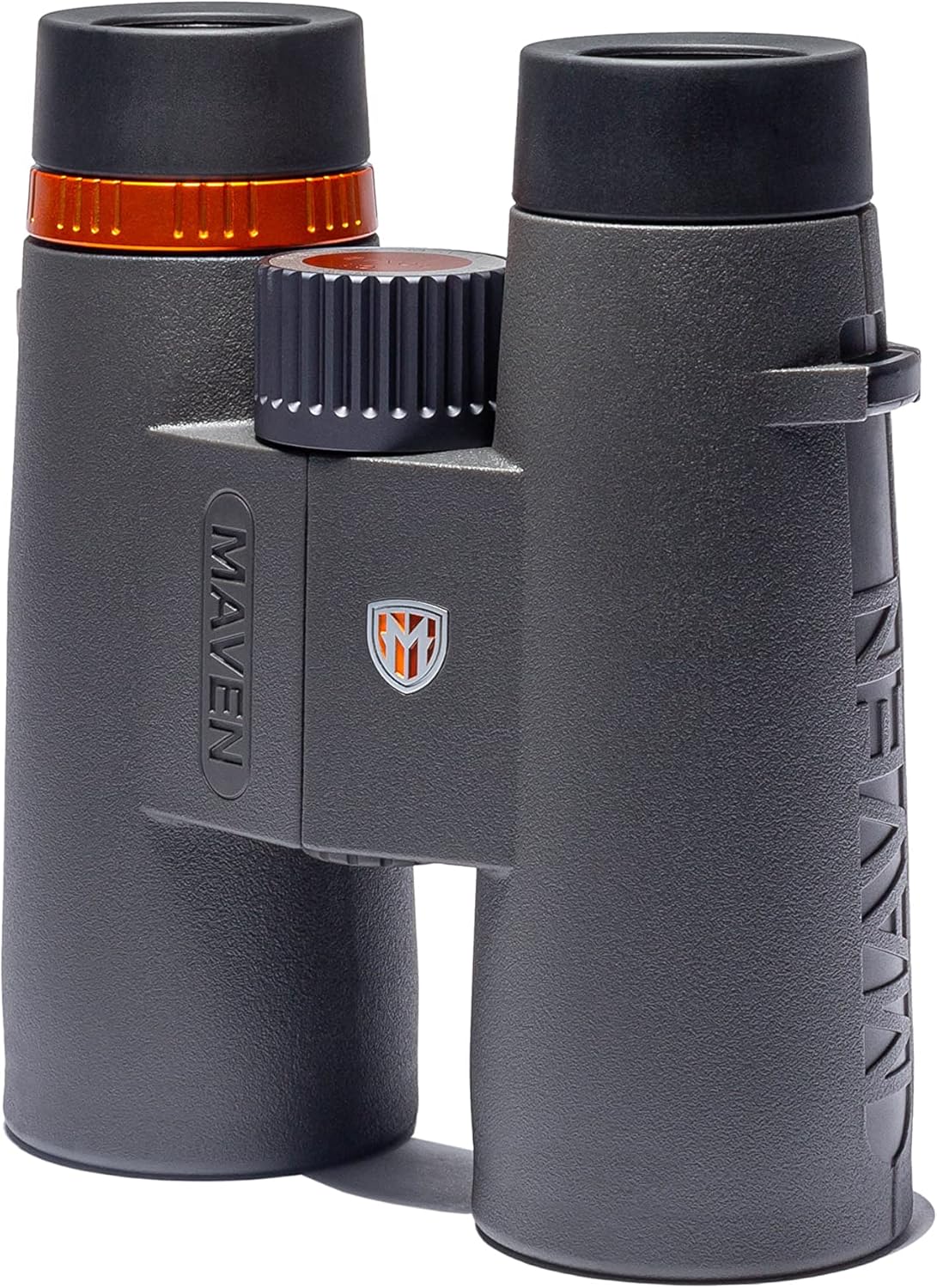
Made in-house, Maven sells its wares directly to customers.The following are some of the most important specs: a lightweight polymer frame, ED glass, fully multi-coated lenses, and a focal length of 5.9 feet.The holy grail of birdwatching is ED glass at 10x, which allows you to see faraway ducks while still being able to distinguish their colors. According to reviewers, the closest focus is the most surprising aspect – 5.9 feet on a 10x pair is very close.
The polymer frame doesn’t feel as sturdy as magnesium alternatives, supplies are low and often unavailable, and using 10x requires steady hands throughout lengthy scans.Ideal for: aviators in search of long-range ED glass. People who require a metal chassis should not buy this.Glare from a ship without its distinctive emblem.
8: Vortex Razor HD 12×50 Binoculars

Nothing here is as difficult to suggest as the Razor HD, and nothing here resolves details quite like it.Important features include an open-hinge magnesium chassis, plasma-tech anti-reflective coatings, premium high-density glass, hand-selected prisms, and a 12×50 lens.Reviewers have noted detail on faraway birds that lesser tiers fail to discern, demonstrating the lineup’s leadership in low-light brightness and resolution. Despite its diminutive stature, the magnesium chassis is surprisingly sturdy and well-balanced.
Important information: the 50mm body is heavy all day, the restricted field makes finding a bird under cover slow, and at 12x every heartbeat shows in the view, so a tripod becomes close to required.Ideal for: people who want to observe the countryside from a tripod. Those who enjoy wandering in the woods or observing birds will not enjoy this.Unusual glass that most birdwatchers will find unappealing.
Things to Consider Before Buying a Binocular:
Choosing binoculars requires careful consideration of various factors that match your specific needs. Whether for birdwatching, sports events, or stargazing, understanding essential features can enhance your overall experience. Knowing what to look for will empower you to make an informed investment in the right pair.
Roof Prism vs. Porro Prism Designs
Choosing between Roof and Porro prisms significantly impacts your binocular experience. Roof prism designs feature a more compact, straight-line configuration, making them ideal for hiking or birdwatching, where portability is essential. In contrast, Porro prisms offer a wider field of view due to their offset lens arrangement, appealing for wildlife observation or stargazing. Each design caters to different activities, allowing you to match the binocular type with your specific needs.
Specialty Optics for Marine and Astronomy Use
Specialty optics serve unique purposes, particularly in marine and astronomy fields. Marine binoculars typically include waterproofing and buoyancy features, ensuring durability in harsh conditions. Astronomy-focused optics tend to offer enhanced magnification with larger objective lenses for clearer cosmic imagery. Opting for binoculars designed for these specific activities can improve your experience, whether on a boat or gazing at celestial bodies.
Magnification and Objective Lens Diameter
Focusing on magnification, it represents how much larger an image appears compared to the naked eye. A higher magnification yields a closer look but may compromise image stability and brightness. Objective lens diameter, measured in millimeters, influences light-gathering ability; larger diameters capture more light, offering clearer images in low-light conditions. For example, an 8×42 binocular provides a good balance of magnification and light transmission, making it ideal for various viewing scenarios.
Lens Coatings and Glass Quality
Considering lens coatings, these impact light transmission and reduce glare, enhancing overall image quality. Fully multi-coated options offer superior performance compared to standard coatings. Quality of the glass itself also plays a significant role; high-quality optics minimize chromatic aberration and enhance clarity. BAK-4 prisms, commonly found in premium models, provide sharper images by improving light management through the prism system.
Advantages of Nitrogen Purging and Waterproofing
Nitrogen purging prevents internal fogging by displacing moisture, ensuring a clear field of view in diverse weather conditions. Waterproofing increases longevity by shielding components from damage caused by rain or humidity. Investing in binoculars with these features is particularly beneficial for those engaged in outdoor activities, as they enhance reliability in unpredictable environments. Users experience a noticeable difference in performance, especially when observing in wet or fluctuating temperatures.
Trade-offs Between Portability and Image Stability
Portability often suffers when opting for advanced stabilization technologies or larger objectives. While image stability enhances viewing experiences, especially during prolonged observation, these features can translate into bulkier designs. Many enthusiasts find themselves choosing between manageable weight and superior optics, affecting overall ease of use during outings. Assessing personal priorities, such as travel frequency or viewing habits, aids in determining the best balance for individual needs.
Establishing a Realistic Price Range
Determining a realistic price range is essential, as binoculars vary widely in cost based on brand, optics quality, and features. A beginner might find satisfactory options in the lower price range, while serious enthusiasts may need to invest significantly more. Setting a clear budget upfront can prevent overspending and help focus on models that meet your requirements without compromising on quality.
Checking for Collimation and Eye Relief
Collimation refers to the alignment of optical elements, impacting the clarity of your view. During testing, look through the binoculars at a distant object, such as a tree or sign. If the image appears double or blurred, collimation may be off. Eye relief is critical for comfort, especially if you wear glasses. Ensure the eyepieces provide sufficient space for your lenses while still allowing you to see the entire field of view without strain.
Evaluating Focus Wheel Smoothness and Grip
Focus wheel performance affects the ease of adjusting your binoculars while observing. Try turning the focus wheel to see how smoothly it operates; an ideal focus wheel should require minimal effort and not be too loose or stiff. Grip texture is equally important, especially in wet or cold conditions. Handling the binoculars will reveal if the materials used provide a secure hold without slipping during use, enhancing overall usability in various environments.
Final Words
Consideration of all factors before purchasing binoculars can greatly enhance your experience. Evaluate the intended use, whether for birdwatching, sports, or stargazing, as different activities require different specifications. Think about comfort and weight, especially for extended use, as well as optical quality, which directly impacts clarity. Always test the binoculars in-store, if possible, to ensure they fit comfortably and meet your expectations. Taking these elements into account leads to a more informed decision and a satisfying purchase.
Leave a Reply