
Searching for the best electric scooters for kids can feel overwhelming. You want a safe ride that delivers unforgettable fun, but how do you choose the right one? We’ve done the hard work for you, testing the top-rated youth scooters for safety, battery life, and pure excitement. This guide makes finding the perfect match for your child simple and stress-free. Let’s dive into our top picks and help you make a confident choice for their next adventure.
Contents
- Top 5 Electric Scooters for Kids:
- 1. Segway Ninebot C2 Pro – Best Electric Scooter for Kids Overall
- 2. Razor Power Core E90 – Best Durable Starter Electric Scooter for Kids
- 3. FanttikRide C9 Pro – Best Adjustable-Height Starter Electric Scooter for Kids
- 4. Gyroor H30 Max – Best Bluetooth Music Electric Scooter for Kids
- 5. Gotrax Gks Lumios – Best Budget Electric Scooter for Kids
- Things to Consider Before Buying a Electric Scooters for Kid:
- Importance of Speed Limit Adjustments
- The Role of High-Quality Brakes
- Why Size Matters: Choosing the Right Model
- Understanding Weight Limits for Optimal Performance
- Assessing Battery Capacity for Daily Use
- Impact of Terrain and Riding Style on Battery Life
- Analyzing Features Across Different Price Points
- Navigating Online Reviews for Authentic Experiences
- Expert Insights: What Industry Leaders Recommend
- Summing up
Top 5 Electric Scooters for Kids:
1. Segway Ninebot C2 Pro – Best Electric Scooter for Kids Overall

The Segway Ninebot C2 Pro If your little one is ready to make the switch from sneakers to wheels, this is the ultimate ride for him or her, ensuring every trip feels like an adventure. Specially designed for young riders, this eKickScooter offers the best combination of speed, safety and fun.
It rides at speeds of up to 12.4 mph (don’t worry, parents — that’s fast enough to be exciting, but not fast enough to be scary) on a zippy 150W motor. On a full charge, it can travel 9.3 miles, so your child gets tons of play time before it needs a quick 4-hour recharge. This scooter also is able to withstand a weight of up to 132 lbs.
Thanks to the adjustable handlebar height, the C2 Pro is for life, not just for Christmas, it grows with your little one and has three different height settings for the perfect fit. Riders can also select from one of three riding modes, so it is easy to adjust whether you are just starting out or ready to hammer.
But the experience doesn’t end as some standalone mode of getting from A to B. Dynamic lights that respond to the beat give children even more reason to crank up their favorite Tunes with the Built-In Bluetooth speaker. Factor in the useful digital display and quick release folding mechanism and you have a scooter that is as practical as it is enjoyable.
The Segway Ninebot C2 Pro transforms everyday trips into epic adventures, giving kids the freedom, style, and endless fun, only on their two wheels.
2. Razor Power Core E90 – Best Durable Starter Electric Scooter for Kids
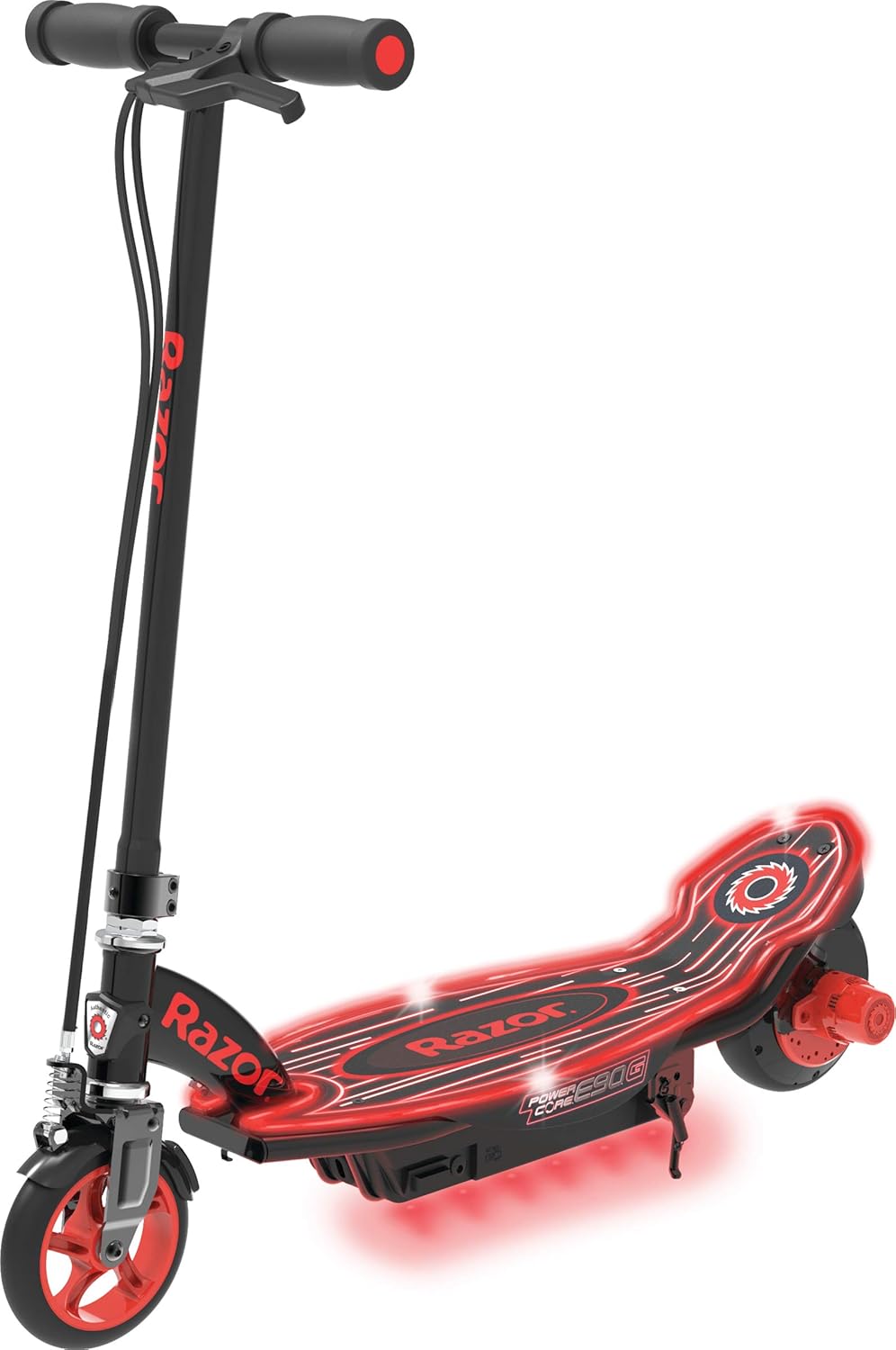
It’s the ideal first electric scooter, at just the right size and power level for new riders who are ready to join in on a twist-throttle journey. It’s tough, yet it’s designed to be fun, and it’s light enough for some good old fashioned beginner bouncing.
The E90 will make their journey looks as cool as can be—literally. An electroluminescent wire runs the length of the deck to give your ride a suitably futuristic glow, while six-LEDs mounted below the deck light up your ride for a neon feel that is sure to light up the neighborhood.
What’s Powering The Fun Razor’s Power Core Technology, of course! Smooth, stable high-torque acceleration is powered by a durable chain-driven motor that’s 90 watts for the Razor E100 and 200 watts for the E200 and E300. No chains and no adjustments make this the perfect introductory toddler tricycle that a parent can simply push and steer, then eventually coach and pedal away!
Featuring a hand operated rear brake, spring loaded kickstand, rubber hand grips, and a push button throttle, watch your child and their friends enjoy the E90 for up to 60 minutes of continuous use With a 12V rechargeable battery system. That’s a whole hour of charging fun before you have to charge it up again.
Durability is where this scooter truly shines. The durable steel frame and fork pedals provide a smooth, comfortable ride featuring an all-steel frame, integrated rear fender, and includes a kickstand. School’s In Session with this Tough and Ready Trolls bike with removable training wheels! And with a weight limit of 120 pounds, it’s an ideal starting point for developing riders.
The Razor Power Core E90 isn’t just another scooter—it’s a glowing, trusted, confidence-building ride that gets your kid away from a screen and into an active childhood the right way.
3. FanttikRide C9 Pro – Best Adjustable-Height Starter Electric Scooter for Kids

For the cost-conscious or someone shopping for a first electric scooter that’s fun, safe and can still accommodate an older kid, FanttikRide C9 Pro is a winning bet. Designed for riders 8-12 years old, the kiddo-friendly design of the Youth Sith helmet will have the little ones searching for Ewoks on the trails.
And with three adjustable speeds — 5, 8 and 10 mph — your kid can ease into it and gain confidence before revving things up a bit. A blacklit LED display keeps them informed with the speed, battery life and pedal mode at a glance. No mystery here — effortless riding only.
The adjustable handlebar will grow with your little, starting at 31.7”, 34.1”, and all the way to 36.5”. Made for 3.9 to 5.2 foot tall riders and up to 132 lbs, it’s made to last years of play. And when the adventure is done, the one-step folding design is perfect for packing it into the car or storing at home.
The 5 mode flashing LED lights give the scooter some added style but even more importantly also gives the rider some extra visibility in the dark for when they are riding their scooter at night. Ride smooth on the street and the pavement with high performance 110mm wheels and abec 9 bearings with 6 inch Anti-skid rubber wheels halt the scooter on a dime and keep you in control. Go up to 5 miles on a single charge, giving you the freedom you need and the fun you want.
4. Gyroor H30 Max – Best Bluetooth Music Electric Scooter for Kids

If you have a child who wants something more than just a scoot around, and craves an adventure with a soundtrack, the Gyroor H30 Max is the scooter for them. Designed for ages 6 to 14, it’s more than your average electric scooter, it’s a rolling party.
With a 150W motor and a rechargeable 21.6V/2.6Ah battery, this scooter can hit three speeds while keeping rides both safe and exhilarating: 6, 8, or 10 mph. It even tackles hills with a small grade effortlessly and riders up to 132 lbs. With performance like that, all trips are worthy of bragging rights.
Safety isn’t left behind. The electronic brake and rear foot brake make an emergency stop when necessary immediately. The rear fender serves double duty as protection from splashes (keep those puddles in their place).
What really distinguishes the H30 Max is the integrated Bluetooth speaker. Sync it to a phone, turn up the playlist and ride music-blaring, all while flashing LED lights on the panel keep it bright and cool.
The handlebar is also adjustable according to your child’s growth, with the height level at 34, 36, and 38 inches. At just 13.2 lbs, it is a lightweight, portable, and extremely manageable scooter for smaller riders.
Gyroor H30 Max Every ride is not just a commute but a show.
5. Gotrax Gks Lumios – Best Budget Electric Scooter for Kids

If you’re looking for a scooter for your child that’s cheap, cool, and safe, then the Gotrax GKS Lumios is the one for you! It was designed with simplicity in mind and features easy-to-use controls, making learning to ride it a breeze, but is packed with enough excitement to satisfy your little adrenaline junky for years to come.
In no time at all, your little rider can master the controls, pressing the right buttons for acceleration, and the left for braking. With a 150W motor, they’ll zip along at a safe top speed of 7.5 mph, and go up to 6.25 miles before needing a recharge. That’s a lot of rides around the block, runs to the park and weekend play.”
The illuminated LED wheel is where the action really shines — and it lights up, literally. Once they get rolling, the front wheel lights up as bright as a headlight, turning rides into impromptu light shows that make them stand out morning, noon or night.
Safety is the priority with dual braking: an electronic brake and a rear foot brake for reliable stops. Throw in a nonslip deck and a rugged aluminum frame, and you have a scooter ready to bring fun and peace of mind to the fold.
The adjustable handlebars expand and grow with your child, so your kid can enjoy their scooter for longer, from 32.5” to 37” it’s perfect for all kids aged 6-12 years old and can hold children, adults up to 154 lbs.
Whether you are giving it to a child for a birthday, or ‘just because’, this is the ultimate gift for allowing kids to enjoy the great outdoors, and your child will be sure to love it.
Things to Consider Before Buying a Electric Scooters for Kid:
Kids need a scooter that matches their age, size and skill, so you should evaluate weight limits, maximum speed and stability; inspect braking systems, battery range and safety certifications. You must ensure helmets and protective gear fit your child, choose durable construction with simple controls and parental speed limits, and verify warranty, local service options and clear supervision guidelines to keep your child safe.
Importance of Speed Limit Adjustments
Set maximum speeds according to age and skill: keep under‑6 riders below 6 mph (10 km/h), 6–12 year olds between 8–12 mph (13–19 km/h), and allow teens up to 15 mph (24 km/h) only with supervision. Look for scooters offering 3‑speed modes, app‑based parental locks or a physical key switch so you can cap top speed and limit acceleration curves; brands like Razor and Segway‑Ninebot provide firmware profiles and child‑safe start modes to prevent sudden bursts.
The Role of High-Quality Brakes
High‑quality brakes determine stopping distance and rider confidence; prefer mechanical disc brakes paired with regenerative or electronic braking rather than relying on a rear‑foot pad alone. Target rotor sizes around 120–160 mm and sealed calipers for better wet‑weather performance, and choose systems with a responsive hand lever and redundant braking methods so a single failure won’t leave your child unable to stop.
Maintain brakes by inspecting pads monthly and replacing them when thickness falls below 1.5–2 mm; check cable tension and lever travel every 4–6 weeks under heavy use. Hydraulic discs should be bled annually and mechanical systems need pad alignment and rotor trueness checks. Always test braking at low speed (3–5 mph) after adjustments—any spongy lever feel, grinding, or persistent squeal warrants immediate servicing.
Why Size Matters: Choosing the Right Model
Deck length, handlebar height, and wheel diameter directly affect comfort and control: a child should stand with knees slightly bent and wrists level with handlebars. Smaller kids often need 100–150 mm (4–6 in) wheels for maneuverability; larger riders perform better with 150–200+ mm (6–8 in) wheels for stability over cracks. Choose an adjustable handlebar that covers at least 10–20 cm of growth.
Understanding Weight Limits for Optimal Performance
Manufacturers publish maximum rider weights—common tiers include ~20 kg (44 lb), 30 kg (66 lb), 50 kg (110 lb), and 70 kg (154 lb)—and exceeding them risks motor strain, reduced range, degraded braking, and voided warranties. You should match your child’s current weight to a rating rather than push a borderline model, since overloading accelerates wear on belt or hub motors and shortens battery life.
Practical rule: pick a scooter rated about 20–30% above your child’s present weight to allow growth and occasional cargo like a backpack. For example, a 18 kg (40 lb) child rides better on a 25–30 kg (55–66 lb)‑rated scooter. Expect heavier loads to increase stopping distance and decrease range, so prioritize higher wattage motors (150–250 W) and quality brakes if your child is near the limit.
Assessing Battery Capacity for Daily Use
Calculate your child’s daily roundtrip first: a 2–3 mile (3–5 km) commute can be handled by a 150–200 Wh pack, while repeated longer trips benefit from 250–300 Wh. For example, a 200 Wh scooter rated at 12 miles might reliably give 8–10 miles in real use; higher capacity increases weight and cost, so balance range needs with portability and storage.
Impact of Terrain and Riding Style on Battery Life
Hills, stop-and-go patterns, and sustained high speeds drain batteries rapidly: climbing steep grades can cut range by 30–50%, and riding at top speed uses energy far faster than cruising at moderate pace. Rider weight and tire pressure also matter—an extra 20 lb (9 kg) reduces range noticeably—so expect real-world range often 20–40% below flat-road claims.
In field tests a 200 Wh scooter advertised for 12 miles fell to about 7–8 miles on mixed hilly routes with a 55 lb (25 kg) child pushing speeds; the same scooter reached closer to 10–11 miles on flat pavement at moderate speed. Cold weather around 0°C can shave another ~10–25% off range, and underinflated tires or frequent acceleration further worsen results, so plan buffer distance accordingly.
Analyzing Features Across Different Price Points
Compare motor power, battery chemistry, and braking systems across tiers: entry-level often uses brushed motors and low-capacity Li‑ion giving 5–7 miles and top speeds ~6–10 mph, while mid-range upgrades to brushless motors, 150–300Wh batteries, disc or regenerative brakes, and LED lights. Inspect deck material, tire type (solid vs. pneumatic), max rider weight (commonly 50–100 lb for kids), and certifications like UL2272—those specs predict durability and safety more than price alone.
Filter for verified purchases, scan low-star reviews for repeated problems, and search within reviews for keywords such as “battery,” “brakes,” “assembly,” and “weight limit.” You can watch a 2–5 minute unboxing and test-ride clip to confirm build quality; if multiple reviewers report battery dropping to 50% capacity within six months, treat that as a significant red flag before buying.
Expert Insights: What Industry Leaders Recommend
Industry experts prioritize UL2272 electrical certification, helmets and brakes rated for the child’s weight, and speed limits tailored to age: many recommend 6–8 mph for younger kids and up to 10–12 mph for older children. You should target battery range of 6–12 miles per charge and choose models with torque and gearing adequate for local hills; dependable brands often publish lab-tested specs and third-party crash or endurance tests.
Experts also advise sizing the scooter to the child: pick a model with a weight limit at least 1.5× your child’s current weight to preserve performance and longevity. For ages 6–8 aim for top speeds under 8 mph and low deck height for stability; for ages 9–12 consider 8–12 mph with regenerative or replaceable batteries. You should favor simple mechanical brakes plus electronic cutoff for predictable stopping.
Summing up
So you should evaluate your child’s age, height and weight limits, maximum speed, battery range, braking systems, frame durability and safety certifications; ensure helmet and protective gear, adult supervision, speed governors or parental controls, local regulations, and easy maintenance and warranty coverage to match your budget and confidence level.
Leave a Reply