
Finding the best travel backpacks is crucial for an effortless and amazing trip. It’s so frustrating when your gear doesn’t fit or your shoulders ache before the adventure even begins! We’ve reviewed the top carry-on bags for the ultimate blend of comfort and smart organization. This guide makes choosing the perfect travel partner simple, ensuring your focus stays on the journey ahead. Let’s dive into the top contenders that will transform your packing experience.
Contents
- Top 5 Travel Backpacks:
- 1. Cotopaxi Allpa 35L – Best Travel Backpack Overall
- 2. Osprey Farpoint 40L – Best Men’s Carry-On Travel Backpack
- 3. Earth Pak Backpack – Best Waterproof Travel Backpack
- 4. Asenlin 40L Backpack – Best Travel Backpack With Packing Cubes
- 5. MATEIN Carry on Backpack – Best Budget Travel Backpack
- Things to Consider Before Buying a Travel Backpack:
- Daypacks
- Hiking Backpacks
- Wheeled Backpacks
- Size and Capacity
- Comfort and Fit
- Durability and Material
- Test-Fitting
- Researching Brands
- Checking Reviews
- Advantages
- Disadvantages
- Cleaning
- Storage
- Final Words
Top 5 Travel Backpacks:
1. Cotopaxi Allpa 35L – Best Travel Backpack Overall

If your travel habits veer from red-eye flights to rainy bus stations, the Cotopaxi Allpa 35L has your back — literally and emotionally. You have suitcase-style, full-wrap access, so you’re not digging down to the socks to get your charger. Pockets in all the right places help keep the “where did I leave that?” panic to a minimum. In handy reach is the stretch mesh pocket for water, and inside is a front zip accessory pocket with organization to keep life neat – the key clip saves you hunting in every compartment at the hotel door.
You’ll thank us for the three grab handles (side, top and bottom) when you’re yanking it out of an overhead bin or off the baggage carousel. Your 15″ laptop? It rides safe in a padded, fleece-lined sleeve that babies it more than you do. Rolling a suitcase? Slip the Allpa onto the carry handle with pass-through strap and skate by like a seasoned veteran. Need extra carry? Four exterior webbing loops stand ready for pouches, a tripod, or the souvenir you promised yourself you wouldn’t buy.
Security is not an afterthought: lockable main zippers keep out prying fingers. And when you need to book it, the shoulder straps and hip belt tuck out of sight behind sleek panels. When it’s on your back, the harness distributes weight to your hips and the ergonomic shoulder straps make the miles easy. In other words: You stay organized, you remain light on your feet and yes, as weird as it sounds, you zip that bag up with a little more pride every time — because this is one backpack that truly stays in stride with who you are.
2. Osprey Farpoint 40L – Best Men’s Carry-On Travel Backpack

If you need a carry-on that feels like a daypack and totes like a suitcase, the Osprey Farpoint 40L is your trusty wingman. It’s made from durable, lightweight material in the scuff-and-scrape areas, so it shrugs off baggage bins and bus racks and those infrequent cobblestone slides. Translation: you’ve got years with a lot of loading without babying it.
And, when running to catch the train from one platform to another, the stowaway harness and hipbelt deploy super fast so you can transfer weight from shoulders if they threaten mutiny. Checking it? Pack the straps away to keep that clean and snaggable-free profile that won’t get bullied by baggage belts. The fit is dialed in for men, so the carry doesn’t sway about like a fleshy tube sock when you’ve packed more than minimally, because maybe you’ll need a thing one day but probably not.
VIP area for your tech, with a quick access sleeve for your 16\” laptop and tablet – be ready in goodbye time at security without blowing up your pack. External zip toiletry pocket that is an ideal location for daily essentials after hours at 30,000 feet. On the inside, there are enough space and organization to manage a long weekend’s worth of stuff — compression straps wrangle the bulk, pockets rein in chargers that might otherwise wrestle your socks.
Small enough to carry on, trail-worthy and built to last: You travel, you move faster — and everything seems to arrive just like you maybe planned it.
3. Earth Pak Backpack – Best Waterproof Travel Backpack
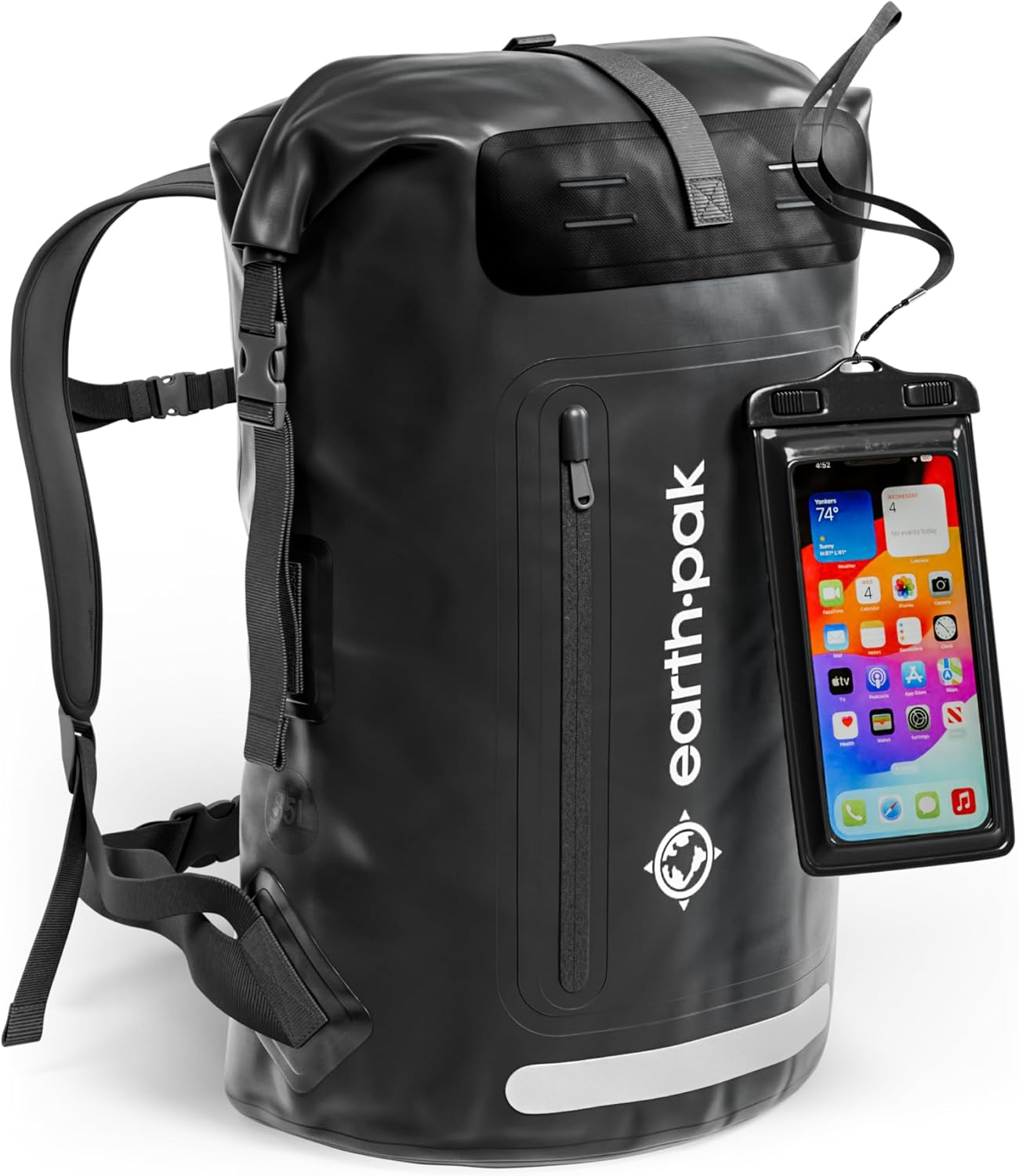
Whether your travels flirt with rain clouds, rogue waves, and surprise puddles, the Earth Pak Backpack is that “keep it dry” trump card you play every time. It’s 100% waterproof, keeping your phone, camera and dry clothes exactly that — dry while you kayak, bike, commuter-carry or cast a line. It’s beautifully simple to close, too: simply roll it down 3–4 times then clip the buckle closed and voila – watertight. Not a fiddly zip, not a crossed finger.
You also get real storage, not just a giant rubbery tube. On the outside, there is a big splash-proof zipper stash for quick-grab items. Inside, a zip pocket, mesh pouch and key ring prevent smaller items from getting lost in the depths. For trips, it’s small and carry-on ready, and those MOLLE loops and D-rings means you can clip gear to the seat of your boat or side of your bike with ease.
Comfort? Covered. The padded back panel is ergonomically designed to keep hotspots away, reinforced contoured shoulder straps adjust for a custom fit and a low profile sternum strap helps distribute the weight on your shoulders. Slap on the heavy-duty waist belt to distribute the load, and you’ll wonder why other dry bags punish so much.
That’s the waterproof pack that doesn’t make you compromise: bombproof where it matters, class-sober where you need sanity, and civilized enough to take on a plane – but tough enough to survive even the rowdiest Thunderstorm. Compress it once and you become the person who always has dry gear and zero drama.
4. Asenlin 40L Backpack – Best Travel Backpack With Packing Cubes

You know that serenity you feel looking into your luggage, with all its tidy packing cubes in a jumble? You receive three personalized storage bags with the carry-on, so tees, socks and toiletries stay in their lanes — plus built-in, elastic bands that hold stacks to keep them from bailing mid-transit. The clamshell opening zips wide for rapid security checks, and the total dimensions cooperate with most airline carry-on rules, which keeps you from being forced to check at the gate at the last possible second.
Your tech gets a safe trip in its own padded sleeve that keeps up to a 17″ laptop separate so it doesn’t get rattled around when the TSA is checking things out. The front pocket keeps cables, passports and pens neatly organized, while the side pocket doesn’t monopolize interior space with your water bottle or umbrella. When you’re wheeling a suitcase, the trolley sleeve slides over the handle; when you’re not, top and side handles make hand-carry simple.
Constructed of water-resistant polyester Oxford cloth and equipped with durable, “explosion-proof” zippers, it battles drizzles and rough baggage belts. Compression straps cinch everything tight, converting a full 40 liters into a leaner day-friendly profile.
Clocking in at 18.5 inches by 12.5 inches by 9.5 inches, it is tuned for weekend getaways, cross-border hops, overnight moves — even for replacing your suitcase if you’d sooner avoid the carousel. Made: out of arrangement, airline-pleasing, cube-powering you travel lighter and faster and vastly less discombobulated.
5. MATEIN Carry on Backpack – Best Budget Travel Backpack

If you’re in the market for a budget carry-on that performs like it’s first class, then the MATEIN Carry-On backpack is your upgrade without the upcharge. It complies with most airlines’ personal-item guidelines, and it fits in the overhead compartments or under the seat in front of you (yes, even on Spirit, Frontier, EasyJet and JetBlue), so you never have to part with your bag.”
You like order? You’ll love four smart compartments. The suitcase-style main compartment accommodates 2 – 3 days worth of outfits with ease. Your 17 inch workhorse is protected in a padded laptop compartment. At the front, pockets secure cords, pens and passports right where you’d expect them. There’s even a secret back pocket, so you won’t lose your wallet and other valuables.
On the move, convenience wins. An external USB port keeps the juice flowing to your phone without you playing outlet Twister. The bottom shoe garage accommodates sizes 10–12 and features vent holes that stave off funk; use it for toiletries or gym gear when the plans change on you.
Constructed for actual travel, not just putting it on display: Durable water-repellent high-density polyester construction; metal zipper heads with lockable pulls in the laptop room (bring a lock). The airflow back panel, padded straps and multi-panel padding make long hikes doable, while padded grab handles, a luggage-pass-through strap and a side mesh pocket keep you mobile (and hydrated) on the run.
From work trip, to weekend dash, to restroom-stop essentials on a spontaneous escape, this budget backpack gets your back. Pack it once and you’ll wonder why you ever contended with a wobbly roller.
Things to Consider Before Buying a Travel Backpack:
Backpack selection shapes how smoothly you travel, so evaluate capacity, weight, and fit to match your typical itinerary and body type. Check materials and weather resistance, test suspension and straps for comfort over long days, confirm organization and access for gear and documents, and verify airline carry-on dimensions if you fly often. Prioritize durability, serviceability, and a warranty to protect your investment.
Daypacks
You’ll pick 15–30 L daypacks for city exploring, short hikes, or as a plane carry-on; expect weights of 0.4–1 kg, hydration-sleeve options, and padded laptop pockets, with popular models from brands like Patagonia and Osprey balancing slim profiles and decent organization.
Hiking Backpacks
Opt for 30–70+ L hiking packs with internal or external frames, adjustable torso lengths, and robust hip belts; a 50 L works well for 2–4 night trips while 60–70 L fits longer treks or winter layers, and look for ventilated back panels and load-lifter straps for stability.
Try on packs with 10–15 kg in them to gauge fit, measure your torso (nape to iliac crest) for correct sizing, and evaluate features: dual-density hip belts, removable lid pockets, sleeping-bag compartments, and reinforced stitching; models like the Osprey Atmos AG and Deuter Aircontact illustrate anti-gravity or heavily padded suspension for comfort on multi-day routes.
Wheeled Backpacks
Wheeled backpacks add 1–2 kg for wheels and a reinforced base but save you shoulder fatigue in airports and paved transfers; many are 30–60 L, offer convertible shoulder straps, and meet checked or carry-on dimensions depending on wheel housing and handle length.
Inspect wheel quality—inline-skate wheels roll smoother on tarmac, twin-spinner wheels invert the pack for back carry, and reinforced retractable handles prevent wobble; choose wheeled designs with stowable straps and durable chassis if you’ll alternate between rolling through terminals and carrying up stairs or cobbled streets.
Size and Capacity
Match liters to trip length: daypacks 15–30L, weekend 30–45L, multi-day 45–65L, expedition 65–85L. You should account for bulky items—sleeping bag adds 10–15L, camera gear 5–10L—and check carry-on size limits (commonly 55×40×20 cm) if you’ll fly. Choose a pack with adjustable collar or lid space for seasonal layering.
Comfort and Fit
Measure your torso from C7 to the iliac crest and pick adjustable suspension to match; test with 10–15 kg loaded so the hip belt can take about 80% of the load. Make sure shoulder straps wrap without pinching and that load lifters keep the top of the pack close to your body. Walk and climb stairs to verify range of motion and breathing room.
Women-specific models offer narrower shoulders and higher lumbar shaping; adjustable hip-belt pockets and varied foam densities change pressure points. Look for sternum straps that stabilize chafing and ventilated mesh backs that reduce direct contact; try a 10–15 minute walk with the pack fully loaded to spot hotspots and tweak strap positions.
Durability and Material
Denier indicates fabric thickness: 70–210D for lightweight packs, 500–1000D Cordura for rugged travel. Examine base reinforcement, taped seams, and YKK zippers; frames and haul handles should use metal or high-strength polymer. For wet climates, expect either a waterproof liner or a rain cover—DWR coatings shed light rain but wear over time.
Ripstop weaves and laminates like X-Pac or Dyneema Composite Fabric (DCF) trade abrasion resistance for lower weight and improved waterproofing. Prioritize higher-denier panels at contact points (base, hip belt, shoulder straps) for adventure travel; choose laminated fabrics and sealed seams if you need true water integrity rather than just water resistance.
Test-Fitting
Load the pack with the weight you plan to carry—8–15 kg for many multi-day trips—and fasten the hip belt so 60–80% of the load sits on your hips; walk, climb stairs, bend, and simulate lifting a heavy item from the ground to check for hip-belt pressure points, shoulder strap dig, and pack sway over 10–15 minutes of movement.
Researching Brands
Compare brands by suspension tech, service policies, and proven models: Osprey (Farpoint/Fairview series, All Mighty Guarantee), Deuter (Aircontact/Aircomfort mesh), Peak Design (Travel Backpack in 30L/45L), Tortuga and Gregory for travel-specific ergonomics; prioritize brands with accessible repairs, clear torso-sizing charts, and model-specific weight/dimension specs.
Dig into brand histories: track record on warranties, typical failure modes reported by owners (zippers, frame, stitching), and whether parts like hip belts or frames are sold separately—brands with global service centers and lifetime or generous guarantees often save you money over repeated long-term travel.
Checking Reviews
Scan verified-purchase reviews and video fit tests; give more weight to reviews reporting 6–24 months of use and those including measured pack weight, torso fit, and real packed examples—products with 100+ reviews and at least 20 long-term reports provide a more reliable picture than a handful of one-off opinions.
Filter for common failure patterns (zipper failures, hip-belt foam collapse, seam wear) and note how the brand resolved issues—check warranty claim anecdotes on forums and Facebook groups, watch tear-down or field-test videos, and prioritize reviews that show identical torso measurements to yours for relevant fit insight.
Advantages
You gain clear trade-offs: a 30–45L carry-on keeps you mobile through airports while a 50–70L trekking pack lets you carry 10–25 kg of camping kit with a suspension system that transfers ~60–80% of load to your hips; daypacks under 30L save weight for urban exploration, and wheeled options spare your shoulders when you’re hauling heavy camera or trade-show gear.
Disadvantages
You sacrifice either capacity, portability, or organization depending on the type: small daypacks limit multi-day gear, large trekking packs add bulk and weight (often 1.5–3 kg empty), wheeled bags fail on uneven ground, and duffels force you to dig for items without internal compartments.
Practical mitigation reduces many downsides: use packing cubes to solve duffel disorganization, test fit with 8–12 kg to confirm hip-belt comfort, check airline carry-on limits (commonly 55 x 40 x 20 cm) before buying, and choose hybrid models (convertible wheels/pack) if you split time between airports and trails.
Cleaning
Empty all pockets and shake out debris, then brush off dried mud with a soft brush. You can spot-clean stains using a mild soap (non-detergent) and lukewarm water below 30°C; avoid bleach. If you machine-wash a pack, remove the hip belt, place the bag in a pillowcase on a gentle cold cycle, skip the dryer, and air-dry upside down out of direct sun. Clean after 3–5 trips or immediately after saltwater exposure or heavy mud.
Storage
Let the pack dry completely before storing to prevent mildew, then zip closed and loosen all straps to relieve tension on stitching. You can stuff the bag with clean cloth or acid-free paper to preserve shape and keep it in a breathable cotton sack or hung by the frame in a cool, dark place (10–20°C). Avoid long-term storage in plastic or attics; add silica-gel packets to absorb residual moisture.
For long-term storage hang the pack by its top handle or frame to avoid compressing foam—folding can crease waterproof coatings and reduce life. You should inspect the bag every three months for pests and moisture, air it on dry days, and treat leather accents with conditioner twice a year. Remove detachable hip belts to prevent deformation during extended storage.
Final Words
Considering all points, you should balance capacity, weight, comfort, durability and organization with trip length, packing style and airline limits; test fit the pack, inspect materials and zippers, verify warranty and water resistance, and prioritize features that make carrying and accessing gear easiest so your backpack reliably supports your travel style.
Leave a Reply